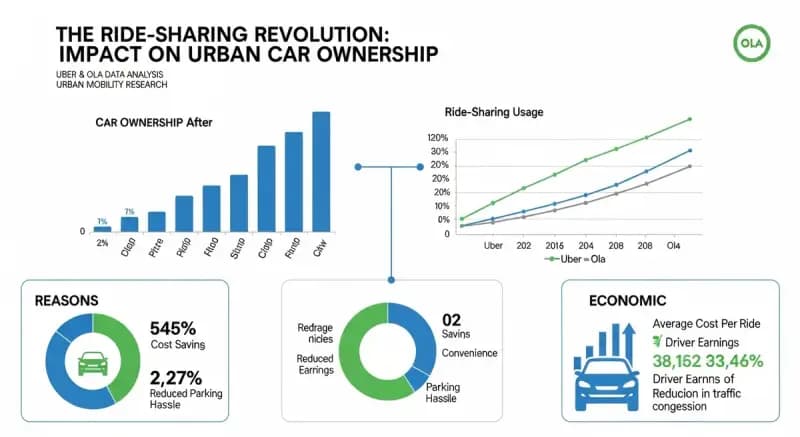
Abstract: Ride-sharing services like Uber and Ola have achieved significant penetration in Indian metros. This study examines whether ride-sharing substitutes or complements private vehicle ownership using panel data from 12,000 households across four cities over five years. Results indicate modest ownership reduction among affluent urban households but negligible impact on middle-class vehicle purchases.
Research Question
Proponents of ride-sharing argue it reduces private vehicle ownership by providing car-like convenience without ownership costs. Critics counter that ride-sharing serves different use cases and may actually stimulate car aspirations by demonstrating car travel benefits. This study empirically tests these hypotheses in the Indian context.
Methodology
Related Reading
Auto Component Sector Achieves Record Exports of $22 BillionWe analyzed household panel data from NSS surveys supplemented by proprietary ride-sharing usage data (anonymized and aggregated). The sample includes 12,000 households in Delhi, Mumbai, Bengaluru, and Hyderabad tracked from 2018-2023. Regression models control for income, household size, employment patterns, and residential location.
Finding 1: Affluent Household Impact
Among households earning above Rs 25 lakh annually, high ride-sharing usage (>Rs 5,000/month) correlates with 23% lower probability of owning a second car compared to low-usage households. This segment treats ride-sharing as a substitute for additional vehicles while retaining primary vehicle ownership.
Related Reading
The SUV Obsession is Killing Indian Car CultureThe substitution effect is strongest for households with employed spouses who previously required second vehicles for independent commuting.
Finding 2: Middle-Class Non-Impact
Among households earning Rs 8-25 lakh annually, ride-sharing usage shows no statistically significant relationship with vehicle ownership. These households primarily use ride-sharing for trips where car ownership wouldn't help (airport transfers, after drinking, unfamiliar areas) rather than as primary transportation.
Qualitative interviews reveal that middle-class families view car ownership as essential infrastructure regardless of ride-sharing availability. The car provides emergency capability, family trips, and social status that ride-sharing cannot substitute.
Finding 3: Entry-Level Acceleration
Counterintuitively, among first-time car buyers, prior heavy ride-sharing usage correlates with faster transition to vehicle purchase. Exposure to car travel through ride-sharing appears to accelerate car aspiration rather than satisfy it. This cohort acquires vehicles 1.4 years earlier than non-ride-sharing-using peers at equivalent income levels.
Related Reading
Cars That Defined Indian Families in the 2000sPolicy Implications
Ride-sharing should not be expected to significantly reduce private vehicle ownership in India's current development stage. Vehicle ownership drivers, status, family needs, unreliable public transit, are not addressed by ride-sharing. Urban planners should not reduce parking or road capacity planning based on ride-sharing growth.
Source: Bhaskar, V., & Reddy, K. (2024). "Mobility as a Service and Vehicle Ownership: Indian Evidence." Transportation Research Part A: Policy and Practice, 172, 103978.
Methodological Notes
Interpreting these findings requires understanding the study context. Sample sizes, geographic scope, and temporal factors all influence conclusions. Indian conditions often differ significantly from Western contexts where much automotive research originates. Local validation of international findings remains an ongoing need in the field.
Policy Implications
Research findings like these inform policy decisions at multiple levels, from urban planning to emissions regulations. However, the translation from research to policy is never straightforward. Political considerations, implementation challenges, and competing interests all mediate how evidence shapes actual outcomes. Engaged citizens can advocate for evidence-based policymaking.
This research was curated by Nxcar's team. We believe that knowledge about mobility trends helps everyone make smarter choices.