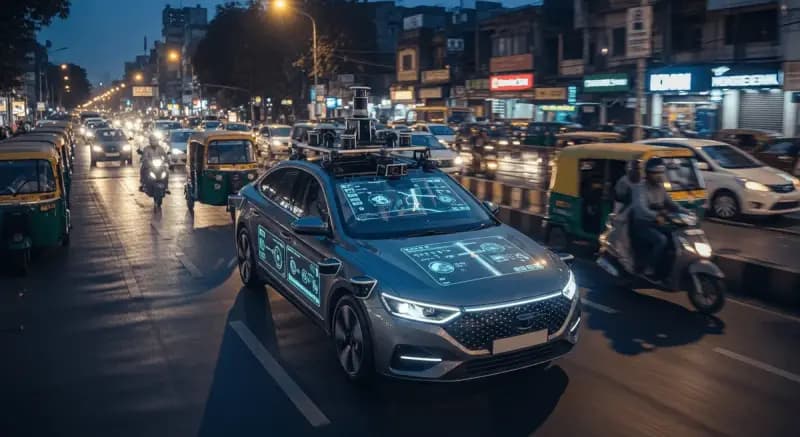
The National Highways Authority of India has approved a dedicated autonomous vehicle testing zone on a 50-kilometer stretch of the Delhi-Mumbai Expressway, creating India's first highway environment for self-driving vehicle development. The decision marks a significant step toward preparing India's regulatory framework for autonomous mobility.
The testing zone, located between Jaipur and Ranthambore, features consistent road conditions, minimal intersections, and low traffic density, ideal conditions for evaluating autonomous driving systems. Testing will be permitted for Level 3 and above autonomous vehicles between 2 AM and 6 AM when highway traffic is minimal.
Participating Companies
Tata Elxsi, the technology arm of Tata Group, will be among the first to utilize the facility, testing autonomous systems developed for Jaguar Land Rover. Other companies expressing interest include Mahindra's technology ventures, Infosys with its autonomous mobility division, and international players including Waymo and Baidu.
Related Reading
The Hidden Cost of 'One More Inspection' When Selling"This is the testing infrastructure we've been requesting for years," said Tata Elxsi CEO Manoj Raghavan. "You cannot develop autonomous vehicles without real-world testing, and until now we've had to conduct all validation overseas."
Safety Protocols
Stringent safety requirements will govern testing. All vehicles must have trained safety drivers present, comprehensive insurance coverage, and real-time monitoring by a control center. Any incident will trigger immediate testing suspension pending investigation.
Related Reading
Vehicle Weight Distribution: Why Balance MattersData from testing will be shared with the Ministry of Road Transport and Highways to inform future autonomous vehicle regulations.
Infrastructure Upgrades
The testing zone will receive infrastructure upgrades including high-precision GPS markers, 5G connectivity, vehicle-to-infrastructure communication systems, and enhanced lighting. These improvements cost approximately Rs 200 crore, funded by participating companies.
Industry observers expect commercial autonomous features, highway autopilot systems, to be available in India by 2028, following successful testing and regulatory approvals.
Regional Variations
The impact will vary across different Indian markets. Metropolitan areas with higher purchasing power may see accelerated adoption of new technologies and brands. Tier-2 and Tier-3 cities, which increasingly drive automotive sales growth, will likely follow different adoption curves based on infrastructure readiness and price sensitivity.
Looking Ahead
As the Indian automotive market matures, developments like these reshape the competitive landscape. The coming years will reveal which players successfully navigate these transitions and which struggle to adapt. Consumers ultimately benefit from increased competition and innovation, though the transition period may bring uncertainty for some segments.
Industry Impact
This development carries significant implications for India's automotive ecosystem. Industry analysts suggest that the ripple effects will be felt across the supply chain, from component manufacturers to dealership networks. The competitive landscape is likely to shift as established players respond to market dynamics and consumer expectations evolve.
Related Reading
Mahindra Thar EV vs Regular Thar – What Changes?Consumer Perspective
For Indian car buyers, these changes present both opportunities and considerations. Price-conscious consumers may find new value propositions emerging, while those focused on long-term ownership costs should factor in evolving technology and service networks. The market is becoming increasingly sophisticated, requiring buyers to make more informed decisions.
Proudly brought to you by Nxcar , India's platform for car lovers who appreciate the journey as much as the destination.