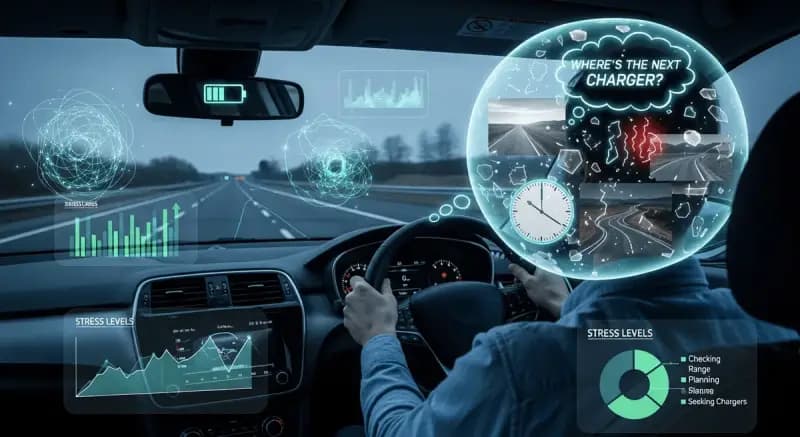
Abstract: Range anxiety, fear of battery depletion before reaching destination or charging, is frequently cited as a barrier to EV adoption. This psychological study examines the cognitive dimensions of range anxiety and evaluates interventions to reduce its impact on purchase decisions.
Theoretical Framework
Range anxiety combines rational risk assessment with irrational fear amplification. Prospect theory suggests losses (stranded vehicle) loom larger than equivalent gains (fuel savings). Availability bias makes vivid failure scenarios salient despite statistical rarity.
Study Design
Mixed-methods study: quantitative survey (n=3,000 prospective car buyers) assessing anxiety levels and stated EV consideration; qualitative interviews (n=60) exploring anxiety narratives; experimental intervention testing information provision effects.
Anxiety Correlates
Range anxiety correlated with: general trait anxiety (r=0.38), unfamiliarity with EVs (r=0.42), rural residence (r=0.35), and higher daily driving distance (r=0.28). Counter-intuitively, actual range of vehicles considered did not correlate with anxiety, 300km and 500km range vehicles generated similar concern.
Narrative Themes
Qualitative interviews revealed anxiety often focused on unlikely scenarios: emergency trips to hospitals, unexpected long journeys, family emergencies. Rational analysis (such trips are rare; planning is possible) didn't reassure anxious respondents.
Intervention Testing
Information interventions (charging network maps, range-under-load data) reduced stated anxiety moderately. Experiential intervention (EV test drives with real-world routes) reduced anxiety substantially. Personal experience outweighed information provision.
Implications
EV marketing should emphasize test drive programs. Rational information alone doesn't overcome anxiety, experience does. Infrastructure investment addresses rational concerns; dealer experience addresses psychological ones.
Source: Consumer Psychology Lab, IIM Lucknow. (2024). Journal of Environmental Psychology, 93, 102207.
Limitations and Future Research
No study is definitive. Acknowledged limitations point toward future research needs. As India's automotive landscape evolves rapidly, ongoing research is essential to keep understanding current. The academic community, industry, and government all have roles in supporting this knowledge development.
Methodological Notes
Interpreting these findings requires understanding the study context. Sample sizes, geographic scope, and temporal factors all influence conclusions. Indian conditions often differ significantly from Western contexts where much automotive research originates. Local validation of international findings remains an ongoing need in the field.
Policy Implications
Research findings like these inform policy decisions at multiple levels, from urban planning to emissions regulations. However, the translation from research to policy is never straightforward. Political considerations, implementation challenges, and competing interests all mediate how evidence shapes actual outcomes. Engaged citizens can advocate for evidence-based policymaking.
From Nxcar's research desk: Our passion for automobiles includes understanding the data that drives the industry.