Silicon Valley techno-optimists love to predict that fully autonomous vehicles are just around the corner. They imagine a future where cars drive themselves while passengers read or sleep. This might eventually work in California. It will never work in India. Here's why.
Chaos is a Feature, Not a Bug
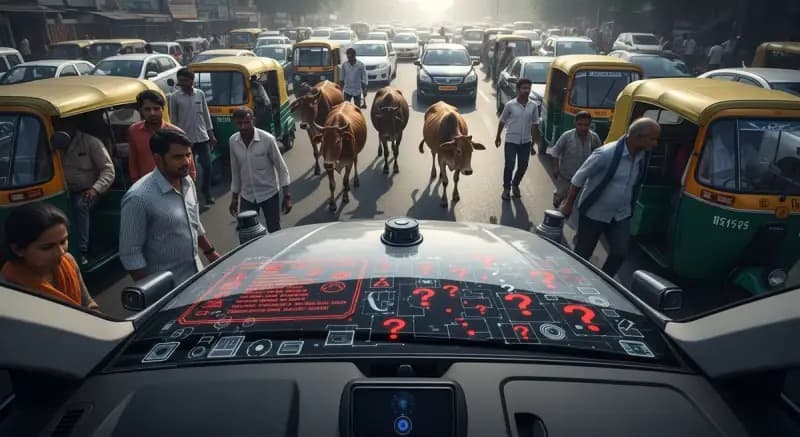
Indian driving operates on an entirely different logic than Western roads. There are no lanes, there are suggested guidelines occasionally painted on asphalt and universally ignored. Vehicles don't maintain fixed positions; they flow like liquid, filling every available gap. The concept of "right of way" is replaced by a complex negotiation of horn signals, hand gestures, and eye contact.
Autonomous vehicles are programmed for rule-based environments. Indian roads operate on negotiation and improvisation. How do you program a car to understand that the truck driver flashing headlights means "I'm coming through" rather than "please proceed"?
Related Reading
Used Car Prices Crash 20% as New Vehicle Supply NormalizesThe Pedestrian Problem
In the West, pedestrians cross at designated crossings. In India, pedestrians cross wherever they want, whenever they want, often while looking at their phones. They expect vehicles to slow or stop. They read driver intentions from subtle vehicle movements.
An autonomous car programmed with American pedestrian behavior would cause accidents or sit paralyzed as humans continuously walk in front of it. An autonomous car programmed for Indian pedestrian behavior would... well, we probably don't want to think about what that would mean.
The Infrastructure Reality
Autonomous vehicles require clear lane markings, consistent signage, updated maps, and reliable GPS. Indian roads offer faded markings, missing signs, construction that changes routes daily, and GPS signals blocked by buildings and bridges.
The potholes alone would confuse LIDAR systems trained on smooth American highways. Our roads are three-dimensional challenges that even human drivers struggle with.
Related Reading
How to Know If a Used Car Is Worth the PriceThe Cow Factor
No discussion of Indian roads is complete without acknowledging the bovine element. Cows sit in the middle of highways. They move unpredictably. They're sacred. How does an autonomous vehicle handle a cow that won't move? How does it distinguish between a cow that will move and one that won't?
I'm not saying autonomous technology has no future in India. But the breathless predictions of imminent self-driving takeover ignore the fundamental reality of our roads. We'll get ADAS features like automatic braking and lane keeping. Full autonomy? Not in our lifetimes.
The Bigger Picture
These concerns aren't isolated incidents but symptoms of systemic issues in India's automotive retail landscape. The power imbalance between dealers and consumers, combined with information asymmetry, creates conditions ripe for exploitation. Understanding this context helps buyers protect themselves and push for better practices.
Related Reading
Chennai Express: Rohit Shetty's Car Carnage Goes South IndianPractical Implications
Beyond the obvious frustrations, these issues have tangible financial consequences. Buyers who fall victim to these practices may find themselves underwater on their purchases within months. The hidden costs accumulate, from overpriced accessories to unnecessary add-ons, eroding the value proposition that initially attracted them to a particular vehicle.
This take comes from Nxcar , where our love for cars includes protecting the people who drive them. Stay curious, stay skeptical.