Used Car Price Depreciation by Brand, Body Type, and Fuel Type in India
Understanding Car Depreciation in India
What is Car Depreciation and Why It Matters
If buying a car feels exciting, watching its value drop over time can feel disappointing. That drop in value is called car depreciation, and in India, it plays a major role in how smart your purchase really is, especially in the used car market.
In simple terms, depreciation is the difference between what you paid for your car and what you can sell it for later. The moment a new car leaves the showroom, it usually loses 15% to 25% of its value. From there, the value keeps declining every year depending on factors such as brand reputation, fuel type, usage, condition, and location.
Why does this matter so much. Because depreciation is often the biggest hidden cost of car ownership. Fuel, insurance, and maintenance are visible expenses. Depreciation quietly reduces your car’s value in the background. If you choose the wrong car, you might lose a large amount of money over a few years without noticing it clearly.
For used car buyers, depreciation can work in your favor. You are buying the car after the first owner has already absorbed the biggest drop in value. That is why understanding depreciation helps you spot which used cars are smart buys and which ones are overpriced.
Not all cars depreciate equally. Some brands hold value well because buyers trust them. Some body types stay in demand more than others. Fuel type also changes resale patterns. In India, where resale value strongly influences buying decisions, depreciation is not only a financial concept. It is a practical decision-making tool.
Average Depreciation Rates in the Indian Market
In India, car depreciation follows a broad pattern, although exact numbers vary by model and condition.
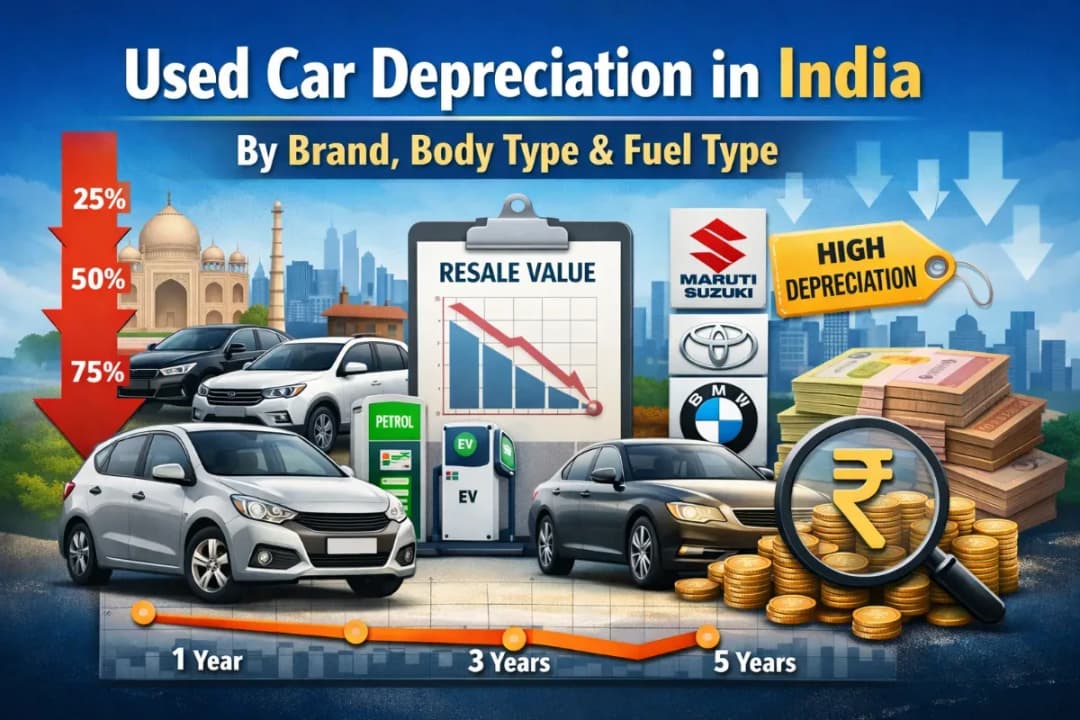
Here is a typical depreciation curve:
- After 1 year: 75% to 85% value retained
- After 3 years: 55% to 65% value retained
- After 5 years: 40% to 50% value retained
- After 8 to 10 years: 20% to 30% value retained
The steepest drop usually happens in the first three years. That is why many buyers consider a 3-year-old car the sweet spot. You get a relatively modern car at a noticeably lower price.
Still, not every car follows the same curve. A Toyota Innova or Mahindra Scorpio may retain far more value due to strong market demand and brand trust. On the other hand, many luxury sedans lose value quickly because maintenance is expensive and the used buyer pool is smaller.
Fuel type matters too. Diesel cars often depreciate slower in some segments because of their mileage advantage. Hybrid and electric cars still show less predictable resale patterns because buyers pay close attention to battery condition and future technology shifts.
When evaluating a used car, do not only ask what it costs today. Ask how much value it has already lost and how much more it is likely to lose. That is what gives you a clearer picture of the real deal.
Depreciation by Car Brand in India
Related Reading
Auto Component Sector Achieves Record Exports of $22 BillionHigh Resale Value Brands
Some brands in India consistently hold their value better than others. These brands have earned strong buyer trust through reliability, low maintenance, and wide service support.
Maruti Suzuki is one of the strongest performers in resale. Models such as the Swift, Baleno, and WagonR stay in demand because they are affordable, easy to repair, and supported by a huge service network. Even after several years, many Maruti cars hold value better than expected.
Toyota is another standout brand. Vehicles such as the Innova and Fortuner are known for durability and long-term reliability. That is why they often command unusually strong used-car prices. Buyers see them as dependable long-term assets.
Mahindra performs strongly too, especially in the SUV segment. Models like the Scorpio, Bolero, and Thar hold value well because they remain desirable in both urban and rural markets.
Hyundai sits slightly behind these leaders but still performs respectably. Cars like the Creta and i20 usually retain value well because of brand strength and wide popularity.
These brands share three clear strengths: trust, service network, and manageable ownership cost. Used-car buyers want predictable ownership, and these brands offer it.
Brands with Faster Depreciation
Some brands depreciate faster in India, even when the cars themselves are good products. The market often discounts them because of higher ownership cost, lower service reach, or weaker used-car demand.
Luxury brands like BMW, Audi, and Mercedes-Benz are the clearest example. These cars often lose 40% to 60% of their value within the first few years. Maintenance, parts, insurance, and a smaller buyer pool all contribute to this sharp drop.
Skoda and Volkswagen also tend to depreciate faster than many mass-market brands. They are respected for build quality and driving feel, but buyers often worry about service cost and spare-part pricing.
Renault and Nissan can also see quicker depreciation, especially when specific models fail to sustain consistent demand in the resale market.
For used-car buyers, fast depreciation is not always bad news. It can create opportunities to buy feature-rich or premium-feeling cars at attractive prices. But you need to be realistic about future maintenance and resale.
Depreciation by Body Type
Hatchbacks vs Sedans vs SUVs
Body type has a strong effect on resale value in India because buyer preferences have shifted sharply over time.
Hatchbacks remain popular because they are affordable, easy to drive, fuel-efficient, and practical for city use. Cars like the Swift, WagonR, and Grand i10 usually retain value reasonably well. Their depreciation is moderate because demand remains steady, especially among budget-conscious buyers.
Related Reading
The Best Car for a Ladakh Trip: Adventure On WheelsSedans have seen weaker resale performance in recent years. While models like the Honda City and Hyundai Verna still have a loyal audience, overall demand for sedans has fallen as buyers move toward SUVs. This shift has made depreciation steeper in many sedan segments.
SUVs currently perform best in the resale market. Compact SUVs like the Hyundai Creta, Kia Seltos, and Tata Nexon, along with larger models like the Mahindra Scorpio, continue to attract strong interest. Their popularity, practicality, road presence, and perceived safety help them retain value better than hatchbacks and sedans.
In general, SUVs now offer the strongest resale position, hatchbacks remain stable, and sedans face the greatest pressure.
Luxury Cars vs Budget Cars
The depreciation gap between luxury cars and budget cars is huge in India.
Budget cars from brands like Maruti Suzuki and Hyundai usually depreciate more slowly and more predictably. They are affordable to maintain, easy to repair, and appealing to a large number of second-hand buyers.
Luxury cars follow a different pattern. They lose value quickly, often within the first few years. A luxury car may look attractive in the used market because the purchase price drops sharply, but the ownership cost often remains high. Service bills, insurance, premium spare parts, and specialized maintenance continue to reflect the original class of the car.
This creates an interesting situation. A used luxury car can look like a bargain, but only if the buyer is prepared for ongoing luxury-level expenses. Budget cars, in contrast, usually offer stronger long-term financial stability.
Depreciation by Fuel Type
Petrol vs Diesel Depreciation Trends
Fuel type has always influenced resale value in India. Traditionally, diesel cars have held value better than petrol cars in several segments, especially SUVs and larger sedans.
The main reason is fuel efficiency. Diesel cars are preferred by buyers with high annual running, which keeps demand strong in the used market. As a result, depreciation has often been lower for diesel variants than for comparable petrol versions.
However, the gap is narrowing. Petrol cars are becoming more attractive because their upfront cost is lower and modern petrol engines are more efficient than before. Diesel cars also face stricter regulations in some places, such as the 10-year usage restriction in Delhi-NCR. That affects their resale value and ownership horizon.
So while diesel still enjoys an edge in some use cases, petrol has become more competitive in the resale market, especially for urban buyers.
Hybrid and Electric Vehicles Depreciation
Hybrid and electric vehicles are still finding their resale pattern in India. Unlike petrol and diesel cars, their market behavior is still evolving.
Hybrid cars, especially from trusted brands, can hold value reasonably well if buyers are confident about battery life and reliability. Strong hybrids are increasingly seen as efficient urban vehicles, which helps support demand.
Electric vehicles are more unpredictable. Their lower running cost improves appeal, but resale depends on battery health, charging convenience, brand trust, software support, and how quickly technology changes. A used EV with a valid battery warranty generally attracts more confidence.
As charging infrastructure improves and battery technology becomes more stable, EV resale patterns will likely become clearer. For now, buyers need to inspect hybrid and electric vehicles more carefully than traditional fuel cars.
Key Factors Influencing Depreciation
Mileage, Condition, and Ownership History
Beyond brand, body type, and fuel type, the actual condition of the car strongly affects depreciation.
Mileage is one of the first things buyers notice. Lower mileage usually suggests lower wear and tear, which supports a higher resale price. But mileage should always be checked along with age, service history, and actual condition.
Condition matters just as much. A car with a clean interior, good paint, proper tires, and healthy engine performance will hold value better than a neglected one. Even small things like dents, scratches, missing records, or poor detailing can influence buyer confidence.
Ownership history also plays a role. First-owner cars generally attract more trust than vehicles that have changed hands multiple times. A clean service record and clear documentation can slow depreciation significantly.
Location, Regulations, and Market Demand
Depreciation also depends on the ecosystem around the car. The city or region where the car is sold influences demand. Compact cars and urban SUVs do well in metro cities. Utility-focused vehicles may perform better in smaller towns and rural markets.
Government regulations can also change resale value sharply. Restrictions on old diesel and petrol cars in certain regions directly reduce their market appeal.
Market demand keeps shifting as buyer preferences evolve. Fuel prices, new launches, safety awareness, and even seasonal buying patterns can all influence how quickly a used car loses value.
How to Minimize Depreciation Loss
Smart Buying Strategies
If you want to reduce depreciation loss, start by buying the right car. Choose high-demand models from trusted brands. Pick a body type that is popular in the market. Match the fuel type to your actual usage instead of following assumptions.
Buying a 2 to 3-year-old car is often the most efficient choice. The first owner has already absorbed the biggest value drop, and you still get a relatively modern vehicle.
Service history, accident record, ownership count, and overall condition should be checked carefully before you buy. A good used car on paper is not always a good used car in reality.
Related Reading
Trucking Culture: The Art, Music, and Life of Indian Long-HaulSmart Selling Timing
When you sell also matters. Selling before a major service milestone or before a new-generation model launches can help you protect value. Cars usually lose more appeal once they cross certain age or maintenance thresholds.
If your region has age-related restrictions, plan your sale before those rules begin to affect demand. Good timing can make a noticeable difference in resale price.
Future Trends in Used Car Depreciation
Used-car depreciation in India is changing as the market evolves. SUVs continue to perform strongly because buyer demand remains high. Petrol cars are becoming more competitive in resale as regulations tighten around older diesel vehicles. Hybrids and EVs are slowly building a place in the market, but battery trust and infrastructure will continue to shape their value.
Future depreciation trends will likely be driven by stricter emission norms, rising interest in cleaner technologies, and changing consumer preferences. Buyers who understand these shifts early will make smarter long-term decisions.
Conclusion
Understanding depreciation gives you a major advantage in the used car market. It helps you look beyond the current asking price and focus on long-term value.
Some brands hold value because buyers trust them. Some body types stay stronger because demand is high. Fuel type, mileage, condition, ownership history, and regulation all shape resale performance. Once you understand these patterns, you stop guessing and start buying smarter.
The best used car is not always the cheapest one today. It is the one that loses value in a way that works best for your budget, usage, and future resale plans.
FAQs
1. Which cars have the lowest depreciation in India?
Toyota, Maruti Suzuki, and Mahindra cars usually show lower depreciation because of strong reliability, high demand, and broad service support.
2. Do SUVs hold value better than sedans?
Yes. SUVs currently hold value better in India because buyer demand is stronger and more consistent.
3. Why do luxury cars depreciate faster?
Luxury cars depreciate faster because maintenance is expensive, spare parts cost more, and the used buyer pool is smaller.
4. Is diesel better for resale value?
In many segments, yes. Diesel cars often retain value better for buyers who prioritize mileage and long-distance use. But location-based regulations matter a lot.
5. Should I buy a car based on resale value?
Resale value should be one of your key decision factors, but it should be balanced with your budget, usage, and ownership goals.