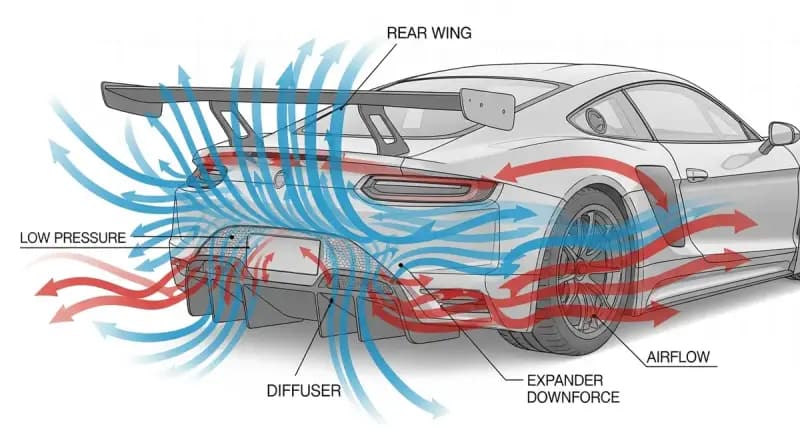
Modern performance cars generate extraordinary downforce, some produce more than their own weight at high speeds. This invisible force fundamentally transforms vehicle dynamics. Here's the physics that makes downforce work and why it's essential for high-performance driving.
Aerodynamic Principles
Downforce is negative lift, instead of pushing the car upward (like an airplane wing), aerodynamic elements push it toward the ground. This is achieved by shaping body elements to accelerate air over the top surface faster than the bottom, creating a pressure differential per Bernoulli's principle.
The force generated is proportional to the square of velocity: doubling speed quadruples downforce. A wing producing 50 kg of downforce at 100 km/h generates 200 kg at 200 km/h. This exponential relationship explains why aerodynamics matter most at high speeds.
Related Reading
Petrol Prices Hit Record High: Impact on Car Buying DecisionsGrip Enhancement
Tire grip is proportional to the vertical force (normal force) pressing the tire into the road. Downforce effectively makes the car heavier for grip purposes without adding actual mass. A 1,500 kg car with 500 kg of downforce can corner as though it weighed 2,000 kg, but accelerates and brakes like a 1,500 kg car.
This is why racing cars can corner at G-forces that would cause mass-market cars to slide uncontrollably. They're not defying physics; they're exploiting aerodynamics to augment grip beyond what tire compounds alone could achieve.
Related Reading
The Uncomfortable Truth About Indian Car Safety StandardsDrag Tradeoffs
Downforce doesn't come free. The aerodynamic elements that generate downforce also create drag, reducing top speed and increasing fuel consumption. Engineers balance downforce against drag depending on application: high-downforce configurations for technical circuits, low-drag setups for high-speed tracks.
Road cars prioritize efficiency over maximum grip, resulting in relatively modest downforce. A Porsche 911 generates perhaps 100 kg at 200 km/h; a Formula 1 car generates 1,500+ kg at the same speed. The difference reflects priorities, not capability.
Related Reading
Should You Buy Diesel After BS6 Implementation for Your Used CarActive Aerodynamics
Modern supercars use active aero elements that adjust based on conditions. Wings extend for high-speed cornering and retract for straight-line speed. Air brakes deploy under heavy braking. These systems optimize the downforce-drag balance dynamically, extracting maximum performance across all conditions.
Understanding downforce transforms how you interpret vehicle behavior at speed. It's invisible but essential, the physics that makes modern performance possible.
Real-World Applications
Theory translates to practice in specific ways. Under Indian driving conditions, with their unique combination of heat, dust, traffic, and road quality, these technical factors manifest differently than in laboratory conditions. Owners should calibrate expectations accordingly, recognizing that advertised specifications often assume ideal conditions.
Related Reading
2026 Tata Tiago Facelift - Top 10 Biggest HighlightsFuture Developments
Automotive technology continues evolving rapidly. What seems cutting-edge today becomes standard tomorrow. Understanding current technical foundations helps owners anticipate future developments and make purchase decisions that won't become obsolete prematurely. The pace of change, particularly in electrification and connectivity, makes this foresight increasingly valuable.
Maintenance Implications
Technical understanding translates directly to maintenance strategy. Knowing how systems function helps owners prioritize servicing, recognize warning signs, and communicate effectively with service advisors. This knowledge pays dividends throughout the ownership period, often resulting in better vehicle condition and higher resale values.
Technical Considerations
Understanding these engineering principles helps owners make better maintenance decisions. When mechanics explain repairs, informed owners can evaluate recommendations critically. This knowledge prevents unnecessary work while ensuring critical maintenance isn't deferred. The goal isn't to become a mechanic but to be a smarter vehicle owner.
From the Nxcar engineering corner: Our passion for cars includes appreciating the brilliant minds that design them.