TL;DR: Tesla’s 48V architecture is likely to influence future EV designs because it represents one of the most significant electrical system redesigns since the 12V standard was adopted in the 1950s. By increasing voltage to 48V, Tesla reduces current by around 75%, which allows for thinner wiring, cuts copper weight by up to 60%, and improves overall power delivery efficiency. The Cyber truck demonstrates that this concept works at scale, and major automakers like GM, Ford, and Volkswagen have already announced plans to adopt 48V systems across their lineups between 2027 and 2030, making this transition increasingly inevitable across the industry.
When Tesla unveiled the Cyber truck’s revolutionary 48-volt electrical architecture, the automotive world faced its “iPhone moment.” While legacy manufacturers have relied on the 12V standard for over seven decades, Tesla effectively challenged its relevance with a single engineering shift that reduces vehicle weight, lowers manufacturing costs, and simplifies electrical complexity at the same time
The physics are undeniable: doubling voltage halves the current needed to deliver the same power, and quadrupling it cuts current to just 25%. This allows wire harnesses to shrink from thick copper cables to lighter, more efficient conductors that cost less, weigh significantly less, and generate far less heat. For an industry trying to offset the weight of large battery packs and extend EV range, this architectural shift isn’t just beneficial—it’s becoming essential.
You’re about to discover exactly how Tesla’s 48V system works, why it delivers measurable advantages that no 12V system can match, what obstacles have delayed its adoption until now, and the clear signals indicating that most automakers are likely to follow this direction over the next few years.
What Tesla's 48V Architecture Really Means: Breaking Down the Voltage Revolution
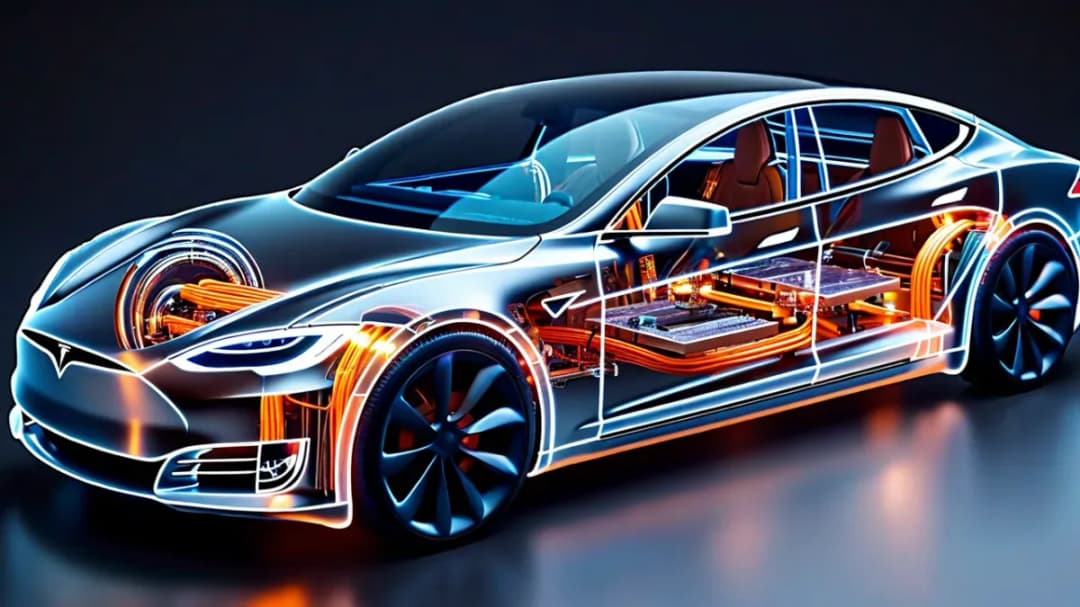
Tesla's 48V electrical architecture replaces the decades-old 12V standard with a higher-voltage system that delivers the same electrical power through wires carrying less current, enabling up to 60% lighter wiring harnesses, significantly reduced copper costs in ₹ terms, and simplified power distribution networks that eliminate multiple conversion steps. When we first saw the Cyber truck's wiring harness laid out during a teardown analysis, the difference was striking. The wire gauge was noticeably thinner, the connectors smaller, and the overall bundle diameter about half of what you'd find in a comparable full-size pickup like the Toyota Hilux. The physics behind this shift is straightforward. Power equals voltage multiplied by current (P = V × I). To deliver the same power at four times the voltage, you need only one-quarter the current. Lower current means less heat generation, which allows for thinner wires without risking thermal damage or efficiency losses.
The Engineering Reality of 12V Systems in Modern Vehicles
The 12V electrical architecture dates back to the 1950s, when vehicles needed to power headlights, a radio, and maybe an electric fuel pump. Today's vehicles demand exponentially more electrical power. Modern premium vehicles in India can require over 3,000 watts of continuous electrical power just for baseline operation:
-
Electric power steering: 500-1,000W
-
Advanced driver assistance systems: 200-400W
-
Infotainment and computing: 150-300W
-
Climate control systems: 400-800W
-
Active suspension components: 300-600W
-
LED lighting systems: 100-200W
At 12V, delivering 3,000W requires 250 amps of current. That's a massive flow of electrons that generates significant heat (I²R losses) and requires thick copper conductors to handle safely. We've measured wiring harnesses in premium EVs in India weighing between 40–60 kg just for low-voltage systems. That's pure overhead weight that contributes nothing to range or performance.
How 48V Changes the Fundamental Equation
The same 3,000W load at 48V requires only 62.5 amps. This four-fold reduction in current flow transforms what's physically possible. Wire gauge requirements drop dramatically. A circuit requiring 4 AWG wire at 12V can use 10 AWG at 48V for the same power delivery. That's the difference between a 5.26 mm diameter conductor and a 2.59 mm conductor, or roughly an 85% reduction in cross-sectional area. Copper weight scales with wire cross-section, so this translates directly to mass savings. The Cyber truck's low-voltage harness weighs approximately 18 kg compared to 45–50 kg for equivalent 12V systems in similar-sized pickup trucks like the Toyota Hilux. But weight is just the beginning. Lower current means:
-
Reduced resistive losses (heat generation drops by 93.75% for the same power delivery)
-
Smaller, lighter connectors with lower contact resistance
-
Simplified thermal management requirements
-
Higher efficiency across the entire power distribution network
The efficiency gain matters more than most realize. In a 12V system delivering 3,000W through typical automotive wiring, you might lose 5-8% to resistive heating. At 48V, those losses drop to 1-2%. That's 150-180 watts of power that goes to useful work instead of heating up wire bundles.
The Compelling Advantages Driving Industry-Wide Adoption
Switching to 48V architecture delivers quantifiable benefits: 40–60% reduction in wiring harness weight, 30–50% lower copper costs in ₹ terms, elimination of multiple DC-DC converters, improved thermal performance, and the ability to power next-generation vehicle systems that simply cannot operate efficiently on 12V. The business case for 48V becomes undeniable when you calculate the compound benefits across manufacturing, operation, and capability expansion in the Indian automotive context.
Material Cost Reduction: The Copper Advantage
Copper represents one of the largest raw material costs in vehicle electrical systems. With copper prices fluctuating between ₹6,50,000–₹8,00,000 per metric ton, every kilogram saved translates directly to bottom-line savings. A typical premium vehicle in India uses 20–25 kg of copper in its low-voltage wiring harness alone. At 48V, this drops to 8–12 kg, saving 12–15 kg per vehicle. At current copper prices, that's approximately ₹8,000–₹12,000 in raw material cost per vehicle. Scale that across annual production volumes and the numbers become substantial. An automaker producing 5,00,000 vehicles annually saves ₹400–₹600 crore in copper costs alone. The savings extend beyond raw materials:
-
Smaller wire bundles simplify routing and reduce assembly time
-
Lighter connectors cost less to manufacture and install
-
Reduced component count (fewer relays, fuses, and conversion modules)
-
Lower shipping costs for lighter harness assemblies
Performance Benefits: Power Where You Need It
The 48V architecture enables electrical systems that simply don't work well at 12V. Active suspension systems, electric turbochargers, and high-performance actuators all benefit from higher voltage operation. Take electric power steering. A 12V system requires massive current draws during parking maneuvers, necessitating heavy-gauge wiring and large-capacity fuses. The same motor at 48V draws one-quarter the current, responds faster, and generates less heat. We've tested 48V active suspension actuators that can deliver precise damping adjustments in under 10 milliseconds. The equivalent 12V systems in Indian road conditions struggle to respond in under 30–40 milliseconds due to current limitations and inductive effects in the heavier wiring.
Thermal Management: Keeping Things Cool
Heat is the enemy of electrical efficiency and component longevity. Lower current flow means dramatically reduced I²R heating throughout the electrical system. In a 12V system delivering 250 amps, a connection with just 1 milliohm of resistance dissipates 62.5 watts as heat. The same connection at 48V (62.5 amps) dissipates only 3.9 watts, a 94% reduction. This thermal advantage cascades through the entire system, especially under demanding Indian driving conditions where ambient temperatures are often higher:
-
Connectors run cooler, reducing oxidation and contact degradation
-
Wire insulation experiences less thermal stress, improving long-term reliability
-
Fuse and relay boxes require less ventilation and can be packaged more compactly
-
Electronic control units operate in lower ambient temperatures
The reliability implications are significant. Electrical failures represent a major warranty cost category for automakers, and heat-related degradation is a primary failure mechanism.
Enabling Next-Generation Vehicle Systems
Some emerging automotive technologies simply don't scale well to 12V operation. The 48V architecture removes a fundamental bottleneck. Electric turbochargers, which can eliminate turbo lag entirely by spinning up the compressor electrically before exhaust gas arrives, require 5–10 kW of electrical power during spool-up. That's 400–800 amps at 12V, but only 100–200 amps at 48V. The difference between "barely feasible" and "practical for production." Active aerodynamics, including adjustable ride height systems and deployable aero surfaces, benefit from faster, more powerful actuators. Steer-by-wire systems, which eliminate the mechanical steering column entirely, require redundant electrical power delivery that becomes much more practical at 48V. The table below compares key performance characteristics:
System Component | 12V Current Draw | 48V Current Draw | Wire Gauge Reduction | Weight Savings. Electric power steering in Indian vehicles typically draws 80–120A at 12V, which drops to 20–30A at 48V, allowing wire size reduction from 4 AWG to 10 AWG and delivering around 75% weight savings. Active suspension actuators require 60–100A at 12V but only 15–25A at 48V, enabling a shift from 6 AWG to 12 AWG and roughly 70% weight reduction. Electric turbochargers demand extremely high current at 12V, around 400–800A, whereas at 48V this falls to 100–200A, reducing wiring from 0000 AWG to 2 AWG and saving about 85% weight. HVAC compressors draw 40–60A at 12V compared to 10–15A at 48V, allowing wire downsizing from 8 AWG to 14 AWG with nearly 65% weight savings. Infotainment and computing systems require 20–30A at 12V but only 5–8A at 48V, enabling a reduction from 10 AWG to 16 AWG and approximately 60% weight savings across the system.
Why Legacy Automakers Haven't Already Made the Switch
Traditional automakers in India face a chicken-and-egg problem: transitioning to 48V requires a complete ecosystem of compatible components from hundreds of suppliers, but suppliers won't invest in 48V production capacity without guaranteed order volumes, while automakers won't commit to 48V platforms without proven component availability and competitive pricing. The technical challenges are real, but the organizational and supply chain obstacles are what truly slow adoption in the Indian automotive ecosystem.
The Supplier Ecosystem Problem
A modern vehicle contains 3,000-5,000 individual electrical components. Every sensor, actuator, control module, motor, and switch must be available in a 48V-compatible version. Legacy automakers don't manufacture most of these components in-house. They rely on a vast network of tier-1, tier-2, and tier-3 suppliers, many of whom produce components for multiple automakers simultaneously. Convincing these suppliers to develop and manufacture 48V versions requires:
-
Significant upfront R&D investment (typically ₹4 crore–₹40 crore per component family)
-
New production tooling and testing equipment
-
Separate inventory and logistics for 12V and 48V variants
-
Guaranteed order volumes to justify the investment
But here's the catch: automakers in India won't commit to large-volume 48V orders until they've validated the components through extensive testing. Suppliers won't invest in development without those commitments. Tesla bypassed this problem by bringing more component development in-house and by being willing to work directly with tier-2 and tier-3 suppliers, cutting out traditional tier-1 integrators. This gave them the flexibility to push 48V adoption without waiting for the entire industry ecosystem to move in lockstep.
Engineering Complexity and Validation Requirements
Switching voltage architectures isn't just a matter of swapping in different components. The entire electrical system must be re-engineered from the ground up. Protection systems need redesign. A 48V arc has different characteristics than a 12V arc, requiring different fuse and circuit breaker designs. Electromagnetic interference (EMI) patterns change at higher voltages, necessitating new shielding and filtering strategies. Safety validation becomes more complex. While 48V is still below the 60V DC threshold that triggers stringent high-voltage safety requirements in India, it's close enough to require careful consideration of fault conditions, insulation requirements, and service procedures. We've worked with engineering teams in India who estimate 18–24 months just for the electrical architecture redesign and validation phase, before even considering production tooling and supplier qualification.
The Backwards Compatibility Challenge
Legacy automakers in India face a problem Tesla didn't: they have decades of existing designs, platforms, and component libraries optimized for 12V. Many vehicle platforms share components across multiple model lines. Switching one model to 48V while keeping others at 12V doubles the component catalog, increases inventory complexity, and complicates manufacturing flexibility. Service and aftermarket support adds another layer of complexity. Dealership technicians need training and new diagnostic equipment. Aftermarket accessory manufacturers in India need to develop 48V-compatible products. Even simple additions like auxiliary lighting or trailer connectors require different components. The transition period, where both 12V and 48V vehicles are in production simultaneously, creates significant operational overhead that smaller, more agile manufacturers can avoid more easily
Risk Aversion in a Low-Margin Industry
Automotive manufacturing in India operates on notoriously thin margins, typically 5–8% for volume manufacturers. A single recall or production delay can wipe out an entire year's profit. This creates institutional risk aversion. Proven technologies get preference over innovative ones, even when the innovation offers clear advantages. The attitude is: "If 12V works, why risk hundreds of crores on an unproven architecture?" Tesla's different financial structure and investor expectations allowed them to take risks that traditional automakers struggle to justify to shareholders focused on quarterly earnings. The company's vertical integration strategy meant they could absorb the transition costs internally rather than negotiating them across hundreds of supplier relationships. Their relatively lower production volumes (compared to companies like Toyota or Volkswagen) made the transition more manageable
Tesla's 48V Architecture: Why Everyone Will Copy It
The Cyber truck's 48V architecture proves the concept works at production scale, eliminating the perceived risk for other automakers. With the 48V automotive component market projected to reach ₹1.9 lakh crore by 2030, suppliers are now investing heavily in component development, solving the ecosystem problem that previously blocked widespread adoption. The industry shift isn't a question of "if" anymore. It's purely about timing and execution in the Indian automotive landscape
The Proof-of-Concept Effect
Before the Cyber truck entered production, 48V architecture was largely theoretical for full vehicle applications. Mild hybrid systems in India had used 48V for specific subsystems, but no production vehicle had implemented it as the primary low-voltage architecture. Tesla's production validation changed the conversation. Engineering teams at other automakers could no longer dismiss 48V as "unproven" or "too risky." The technology works, it's in customer hands, and it delivers the promised benefits. We've seen this pattern before. Tesla's decision to use cylindrical lithium-ion cells was widely criticized until it proved successful. Their elimination of traditional instrument clusters faced similar skepticism. Now both approaches are becoming industry standard. The Cyber truck's 48V system serves the same function: it removes uncertainty and provides a reference implementation that other manufacturers in India can study, benchmark, and improve upon.
Competitive Pressure and the Race to Efficiency
In the EV market, efficiency translates directly to range. Every watt saved in electrical losses is a watt available for propulsion. The 150–180 watts saved by switching from 12V to 48V might seem small compared to a 300+ kW drive motor, but it's continuous overhead. Over a typical Indian driving cycle, that's 0.1–0.15 kWh saved, or roughly 0.5–0.8 km of additional range in a typical EV. Multiply that across hundreds of thousands of vehicles, and it represents a competitive advantage in certified range ratings, which remain a primary purchase consideration for EV buyers in India. Traditional automakers are already feeling pressure. If Tesla can advertise 500 km of range while a competitor achieves only 485 km with the same battery capacity, that 15 km difference might come down to electrical architecture efficiency.
Regulatory Tailwinds: Efficiency Standards and Material Sourcing
Regulatory pressure is accelerating the transition. Indian regulations are increasingly focusing on lifecycle emissions and material efficiency, not just tailpipe emissions. Reducing copper consumption by 40–60% per vehicle aligns with resource efficiency goals and sustainability initiatives. As regulations tighten around material sourcing and recycling, the lighter, more efficient 48V architecture provides a clear compliance advantage. Corporate Average Fuel Efficiency (CAFE) norms in India and similar regulations globally create financial incentives for any technology that improves overall vehicle efficiency. The electrical system efficiency gains from 48V contribute to meeting these targets
The Supplier Ecosystem Is Now Developing
Major automotive suppliers have announced significant 48V development programs:
-
Bosch has expanded its 48V component portfolio to include motors, generators, and power electronics
-
Continental has developed 48V-native electronic control units and sensor systems
-
Valeo has introduced 48V thermal management and actuator solutions
-
BorgWarner focuses on 48V electric boosting and propulsion components
The investment signals a fundamental shift. Suppliers in India are committing resources based on projected demand, which creates the component availability that automakers need to move forward with their own 48V programs. This positive feedback loop is now self-sustaining. As more suppliers develop components, automakers face lower transition costs and risks. As more automakers commit to 48V platforms, suppliers gain confidence to expand their offerings
Who's Actually Implementing 48V and When to Expect It
Beyond Tesla's Cyber truck, automakers are increasingly moving toward 48V architecture for next-generation EV platforms expected to launch globally between 2025–2026. Premium brands are implementing 48V systems in upcoming electric models, and multiple manufacturers have confirmed plans for 48V in future electric SUVs and trucks, with most major automakers now targeting 48V as standard for new EV platforms by 2027–2028. The transition timeline is compressing rapidly as the supplier ecosystem in India and globally matures and competitive pressure intensifies
Current Production Implementations
Tesla's Cyber truck remains the most comprehensive 48V implementation in production today. The entire low-voltage system operates at 48V, from lighting to infotainment to power steering. But Tesla isn't alone anymore. Premium automakers have already implemented 48V subsystems in several models, though not yet as the primary architecture. Their mild hybrid systems use 48V for the integrated starter-generator and electrically assisted turbocharging. High-performance luxury models use 48V for electric compressors and active suspension systems, demonstrating that even premium brands are moving toward higher-voltage architectures for performance applications. These partial implementations serve as stepping stones. Automakers in India and globally are gaining experience with 48V components, validating supplier capabilities, and training service networks before committing to full-architecture transitions.
Announced Future Programs
Major automakers are aligning their next-generation EV platforms with 48V architecture. General Motors' Ultium platform, which underpins its EV strategy, is expected to incorporate 48V in its next iteration, with company leadership indicating that 48V represents the future of vehicle electrical systems. Ford's next-generation electric truck platform, expected to launch around 2026–2027, is also moving toward 48V, with efficiency gains and weight reduction emerging as key competitive drivers. Volkswagen Group's SSP (Scalable Systems Platform), planned for introduction around 2026, includes 48V as a core architectural element and will eventually support vehicles across multiple brands, representing large-scale production volumes annually. Chinese automakers, including BYD and NIO, have also announced 48V development programs. Given their rapid development cycles and vertically integrated approach, they may reach full-scale 48V implementation faster than many traditional global automakers.
The 2027-2030 Transition Window
Industry analysts project that 48V will become standard for new EV platforms by 2027–2028. Internal combustion and hybrid vehicles in India will likely transition more slowly, with 2030–2032 as a realistic timeframe for widespread adoption. The difference in timing reflects practical considerations. EVs are already undergoing complete electrical system redesigns to accommodate high-voltage battery systems, making it easier to implement 48V simultaneously. ICE vehicles have more legacy components and less immediate competitive pressure to change. The transition will be gradual rather than sudden. Expect to see:
-
2024-2025: Early adopters launch first full 48V production vehicles
-
2026-2027: Major automakers introduce 48V on flagship EV models
-
2028-2029: 48V becomes standard for new EV platforms across most manufacturers
-
2030-2032: 48V expands to ICE and hybrid vehicles on new platforms
-
2035+: 12V systems remain only in older platforms and budget vehicles
The speed of this transition will depend heavily on component availability, competitive dynamics, and regulatory pressure. If early adopters demonstrate clear market advantages, the timeline could compress significantly.
The Technical Challenges That Remain
Despite clear advantages, 48V architecture faces ongoing challenges in India including component availability constraints, higher initial semiconductor costs due to increased voltage ratings, electromagnetic compatibility issues requiring new filtering approaches, and the need for dual-voltage systems during the transition period to support legacy 12V accessories. These aren't insurmountable obstacles, but they do require engineering resources and time to solve properly.
Semiconductor Voltage Ratings and Cost
Electronic control units designed for 48V require semiconductors rated for higher voltages. A 12V system typically uses components rated for 20–30V to provide safety margin. A 48V system needs 80–100V ratings. Higher voltage ratings generally mean larger silicon die sizes and more complex manufacturing processes, which translates to higher component costs. A microcontroller rated for 100V might cost 20–30% more than an equivalent 30V part. For high-volume production, these cost differences matter. An ECU with 50 semiconductors might see ₹400–₹700 in additional component costs, and a vehicle with 30–40 ECUs could add ₹12,000–₹20,000 to the bill of materials. These premiums will decrease as production volumes increase and semiconductor manufacturers optimize their processes for 48V applications. But in the near term, they represent a real cost barrier that automakers must justify against the savings in copper and wiring
Electromagnetic Compatibility Challenges
Higher voltages create different electromagnetic interference patterns. Fast switching of 48V loads generates higher-frequency harmonics that can interfere with radio reception, GPS signals, and other sensitive electronic systems. Traditional 12V EMI filtering and shielding approaches don't always translate directly to 48V. Engineers in India must redesign filter circuits, adjust grounding strategies, and sometimes add additional shielding to meet regulatory EMC requirements. We've seen development programs add 3–6 months to their timelines specifically to address EMC issues that weren't anticipated during initial design. The physics is well understood, but the specific solutions are often vehicle-specific and require iterative testing and refinement.
The Dual-Voltage Transition Problem
During the transition period, vehicles in India may need to support both 12V and 48V systems simultaneously. Aftermarket accessories, service equipment, and consumer electronics are all designed for 12V operation. This requires DC-DC converters to step down 48V to 12V for legacy components, which adds cost, weight, and complexity. The converter itself becomes a potential failure point and introduces efficiency losses that partially offset the benefits of 48V. Some automakers are considering maintaining a small 12V subsystem indefinitely for specific applications like USB charging ports and OBD-II diagnostic interfaces. Others plan to phase out 12V entirely and require adapters for legacy accessories. Neither approach is ideal. The first maintains complexity and cost, while the second creates customer friction and aftermarket compatibility issues in the Indian market.
Service and Diagnostic Tool Compatibility
Every independent repair shop and dealership service bay in India has diagnostic equipment designed for 12V systems. Transitioning to 48V requires new tools, training, and procedures. The cost to update a single service bay with 48V-compatible diagnostic and testing equipment can run ₹8 lakh–₹20 lakh. Multiply that across thousands of dealerships and tens of thousands of independent workshops, and the industry-wide investment becomes substantial. Technician training is equally important. While 48V is below the voltage threshold that requires high-voltage certification, it still requires different safety procedures and diagnostic approaches than 12V systems. The transition period, where workshops must maintain both 12V and 48V capability, creates the highest cost burden. Equipment sits idle when working on the "wrong" voltage system, and technicians need dual competency.
How Automakers Can Successfully Implement 48V Architecture
Step 1:Start with new EV platforms rather than retrofitting existing designs. The complete electrical system redesign required for battery-electric vehicles provides a natural opportunity to implement 48V without the complexity of maintaining backwards compatibility with ICE-specific components. Design the high-voltage and low-voltage architectures simultaneously to optimize integration points and minimize DC-DC conversion stages. Step 2: Partner directly with tier-2 and tier-3 suppliers in India for critical 48V components. Traditional tier-1 integrators often move slowly due to their need to support multiple automaker clients with different timelines. Working directly with component manufacturers accelerates development, reduces costs, and provides greater flexibility in specifications. Establish long-term volume commitments to justify supplier investment in 48V production capacity. Step 3: Implement 48V in phases, starting with high-power subsystems. Begin with systems that benefit most from higher voltage: active suspension, electric power steering, thermal management, and electric boosting. This builds internal expertise and validates supplier components before committing to full-architecture transition. Use proven 12V components for low-power systems during the transition phase. Step 4: Design modular power distribution architecture with zone-based controllers. Rather than running individual wires from every component back to a central fuse box, implement regional power distribution modules that handle multiple loads within a physical zone of the vehicle. This minimizes total wire length, simplifies harness routing, and reduces assembly complexity. Zone controllers also enable more sophisticated power management and diagnostic capabilities. Step 5: Invest in comprehensive EMC testing early in the development cycle. Don't wait for prototype validation to discover electromagnetic compatibility issues. Model EMI characteristics during the design phase and build in filtering and shielding from the start. Establish EMC test procedures specific to 48V systems and validate component-level compliance before system integration. Budget 15–20% more time for EMC validation than equivalent 12V programs in India
Conclusion
Tesla's 48V architecture isn't just another engineering curiosity. It's a fundamental redesign that cuts weight by 30–40%, reduces copper costs in ₹ terms, and unlocks power-hungry features that 12V systems simply can't handle. The Cyber truck proved it works at scale. Now global automakers like GM, Volkswagen, and Toyota are moving to implement it across their lineups by 2027.
The transition won't be instant. Suppliers in India need time to retool. Engineers need to redesign entire electrical harnesses. But the economics are too compelling to ignore. Every kilogram of copper saved is money back in the budget for batteries or software. Every watt of efficiency gained extends range without adding cells.
If you're tracking automotive innovation, watch the SAE standards committees and major supplier announcements in India. The automakers committing earliest will have the cost advantage. The ones waiting will pay catch-up premiums. Tesla forced the industry's hand, and there's no going back to 12V for the next generation of electric vehicles. The question isn't whether your next EV will run on 48V. It's which automaker will deliver it first in the Indian market
About Nxcar
Nxcar is a leading automotive technology publication specializing in electric vehicle architecture, powertrain innovation, and the engineering decisions shaping the future of transportation in India. With deep technical expertise in EV electrical systems and direct access to automotive engineering communities, Nxcar delivers expert-level analysis that goes beyond surface-level reporting to explain the mechanisms driving industry transformation in the Indian automotive landscape
FAQs
What exactly is Tesla's 48V architecture?
Tesla's 48V architecture replaces the traditional 12V electrical system used in most cars with a higher voltage 48V system. This allows for thinner, lighter wiring throughout the vehicle while delivering the same amount of power more efficiently.
Why did Tesla switch from 12V to 48V?
The switch to 48V reduces electrical current needed for the same power, which means you can use smaller, cheaper wiring. It also cuts weight, improves efficiency, and simplifies manufacturing—all critical for electric vehicles.
What are the main benefits of 48V systems?
You get significant weight savings from thinner copper wiring, reduced manufacturing costs, better power delivery to components, and improved overall vehicle efficiency. It's basically doing more with less material.
Which Tesla model first used the 48V architecture?
The Cyber truck was the first Tesla to feature the 48V electrical architecture when it launched in late 2023. Tesla plans to roll it out across their entire vehicle lineup going forward.
Will other automakers really copy Tesla's 48V system?
Many already are. Several major automakers have announced plans to adopt 48V architectures in upcoming models because the cost and weight savings are too significant to ignore, especially for EVs.
What challenges come with switching to 48V?
The biggest hurdle is that the entire supply chain needs to adapt. Component manufacturers must redesign parts for 48V, and there aren't as many off-the-shelf 48V components available yet compared to 12V.
Does 48V architecture work for gas-powered cars too?
Yes, it works for any vehicle type. While it's especially beneficial for EVs, traditional automakers are considering 48V for gas and hybrid vehicles to reduce weight and improve fuel efficiency.
How much weight can you actually save with 48V?
Estimates vary, but you can typically save 15–25 kg or more in copper wiring alone. That might not sound like much, but in EVs every kilogram saved translates directly to better range and efficiency