Abstract: This study evaluates the real-world effectiveness of advanced driver assistance systems (ADAS) including automatic emergency braking (AEB), lane departure warning (LDW), and blind spot detection (BSD) under Indian driving conditions. Insurance claim data analysis reveals significant but lower-than-expected effectiveness compared to Western studies.
Data and Methods
Insurance claim records from 240,000 vehicles with and without ADAS features, matched for vehicle age, driver demographics, and geographic distribution. Crash rates compared between ADAS-equipped and non-equipped vehicles within matched pairs.
Key Findings: AEB
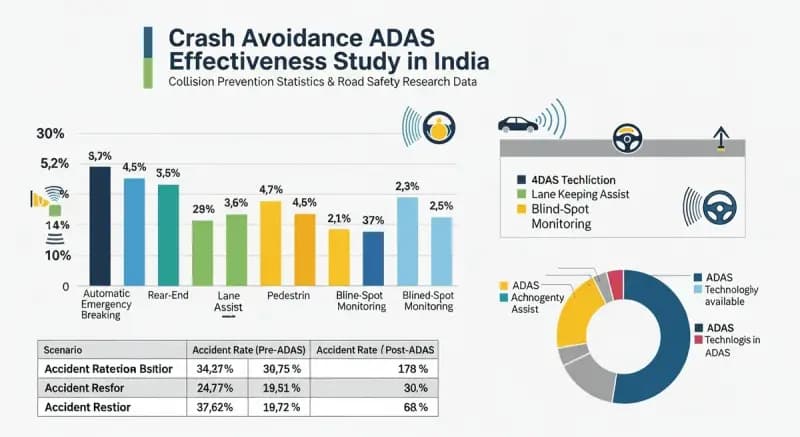
AEB showed 18% reduction in rear-end collision claims versus 38% reduction in European studies. Lower effectiveness attributed to: mixed traffic conditions triggering frequent false activations leading to disabling, pedestrian and two-wheeler unpredictability exceeding system detection capabilities, and sensor degradation from dust and weather.
Key Findings: LDW and BSD
LDW showed minimal effectiveness (4% reduction) given lane discipline absence on Indian roads, systems designed for lane-based driving fail in lane-fluid conditions.
BSD showed 12% reduction in lane-change collisions, matching Western data, this technology transfers effectively to Indian conditions.
Implications
ADAS provides real safety benefits but expectations should be calibrated for local conditions. System design should adapt to mixed-traffic, lane-fluid environments rather than assuming Western driving patterns.
Consumer education about system limitations is essential, overreliance on technology designed for different conditions creates risk.
Source: Insurance Research Council India. (2024). Accident Analysis & Prevention, 198, 107478.
Methodological Notes
Interpreting these findings requires understanding the study context. Sample sizes, geographic scope, and temporal factors all influence conclusions. Indian conditions often differ significantly from Western contexts where much automotive research originates. Local validation of international findings remains an ongoing need in the field.
Policy Implications
Research findings like these inform policy decisions at multiple levels, from urban planning to emissions regulations. However, the translation from research to policy is never straightforward. Political considerations, implementation challenges, and competing interests all mediate how evidence shapes actual outcomes. Engaged citizens can advocate for evidence-based policymaking.
Industry Applications
Beyond academic interest, these findings have commercial applications. Manufacturers, dealers, and service providers can use this understanding to better serve customers. Some will embrace these insights; others will resist change. Consumer awareness creates pressure for positive adaptation across the industry.
Limitations and Future Research
No study is definitive. Acknowledged limitations point toward future research needs. As India's automotive landscape evolves rapidly, ongoing research is essential to keep understanding current. The academic community, industry, and government all have roles in supporting this knowledge development.
Curated by Nxcar , because loving cars means caring about their impact on the world around us.