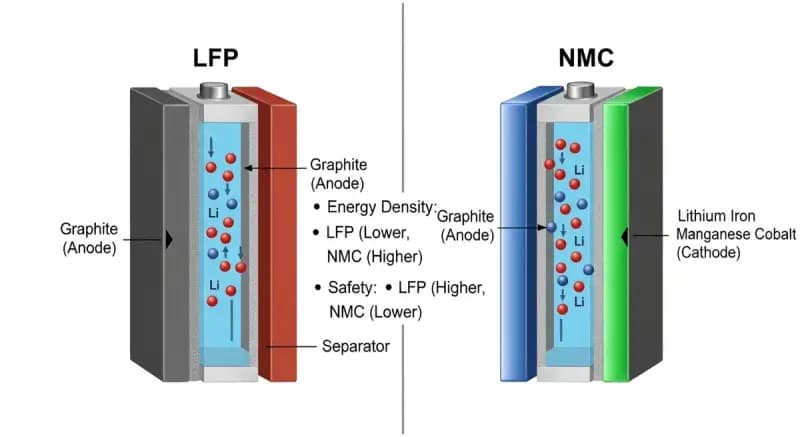
The battery chemistry war has a new frontline: lithium iron phosphate (LFP) versus nickel manganese cobalt (NMC). Chinese manufacturers champion LFP for its safety and cost advantages. Korean and Japanese firms defend NMC's energy density. For Indian buyers, the choice has significant implications. Here's an authoritative comparison.
Energy Density
NMC batteries achieve 230-280 Wh/kg at the cell level; LFP manages 160-180 Wh/kg. This 50% density advantage means NMC vehicles can be lighter or offer more range from the same weight. For performance vehicles and long-range applications, NMC remains superior.
However, cell-to-pack innovations are closing the gap. BYD's Blade Battery achieves pack-level density competitive with modular NMC packs by eliminating intermediate structure. The raw chemistry disadvantage is increasingly offset by packaging efficiency.
Thermal Behavior
LFP's killer advantage is thermal stability. LFP cathodes don't undergo thermal runaway until 270°C, versus 150-200°C for NMC. This fundamental safety margin allows simpler cooling systems and reduces fire risk, critical in hot Indian conditions where ambient temperatures exceed 45°C.
LFP also tolerates high-temperature charging better. NMC cells experience accelerated degradation when charged above 35°C; LFP maintains cycle life. For vehicles parked outdoors in Indian summers, this difference is significant.
Related Reading
How to Sell Your Used Car Quickly in IndiaCycle Life and Longevity
LFP batteries maintain 80% capacity after 3,000-4,000 cycles; NMC typically lasts 1,500-2,000 cycles. For a vehicle charged daily, this translates to 10+ years of usable life for LFP versus 5-7 years for NMC.
LFP is also more tolerant of 100% state-of-charge storage. NMC batteries degrade faster when kept fully charged; LFP can remain at 100% without penalty. This simplifies charging behavior for owners.
Related Reading
Impact of Work-From-Home on Vehicle Utilization PatternsCost Trajectory
LFP cells cost $80-100/kWh at pack level; NMC runs $120-150/kWh. The 30-40% cost advantage enables more affordable EVs without compromising quality. As NMC requires cobalt (expensive and ethically problematic), the cost gap may widen.
Recommendation for India
Related Reading
10 Cars Every Indian Millennial Dreamed of OwningFor urban EVs with sub-400 km range requirements, the majority of Indian use cases, LFP offers superior value: lower cost, longer life, better thermal behavior. NMC remains preferable for premium vehicles where range and performance justify higher costs.
The market is voting with orders: LFP share in global EV production has risen from 10% in 2020 to over 40% in 2024. India should follow this trajectory.
Maintenance Implications
Technical understanding translates directly to maintenance strategy. Knowing how systems function helps owners prioritize servicing, recognize warning signs, and communicate effectively with service advisors. This knowledge pays dividends throughout the ownership period, often resulting in better vehicle condition and higher resale values.
Technical Considerations
Understanding these engineering principles helps owners make better maintenance decisions. When mechanics explain repairs, informed owners can evaluate recommendations critically. This knowledge prevents unnecessary work while ensuring critical maintenance isn't deferred. The goal isn't to become a mechanic but to be a smarter vehicle owner.
At Nxcar, we're fascinated by what makes cars tick. This technical exploration reflects our team's deep appreciation for automotive innovation.