From Raj Kapoor's Chevrolet Impala to Shah Rukh Khan's collection of Bugattis, Bollywood has always used cars as status markers for its heroes. But the relationship between Hindi cinema and automobiles reveals more about aspiration, identity, and cultural change than simple product placement.
The Ambassador Era
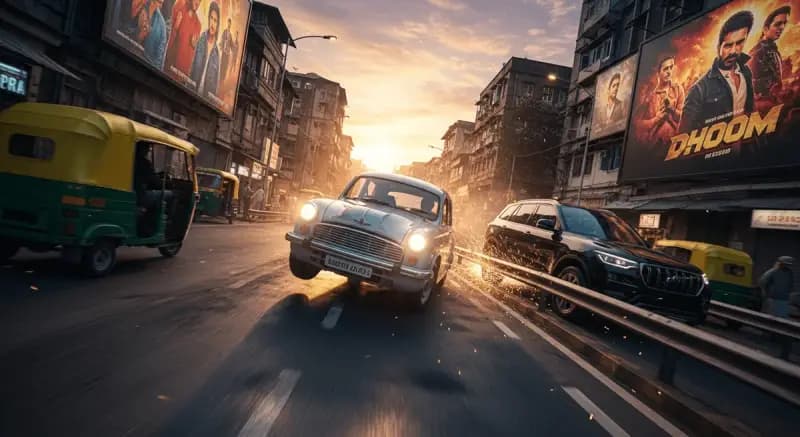
Early Bollywood heroes drove Ambassadors, India's only option. The cars appeared in romantic songs and chase sequences, domestic vehicles for domestic dreams. The Ambassador signified arrival: if you had one, you'd made it in newly independent India.
The Import Era
Liberalization in 1991 transformed cinematic vehicles. Suddenly, heroes drove Mitsubishi Pajeros, Honda Accords, and Mercedes S-Classes. These imports symbolized the new India, globally connected, aspirationally Western, economically liberated.
The cars weren't just props; they were promises. If you worked hard in the new economy, you too could drive what the heroes drove.
The Supercar Era
By the 2000s, regular imports weren't enough. Race (2008) featured Aston Martins and Lamborghinis. Dhoom established supercars as heist-film essentials. Rohit Shetty's films used (and destroyed) more luxury cars than most manufacturers sell annually.
Problematic Patterns
Bollywood's car culture has downsides. It glamorizes dangerous driving. It associates masculinity with expensive machines. It creates aspirations disconnected from middle-class reality.
When a hero races through Mumbai traffic at 200 km/h with no consequences, it normalizes recklessness. When cars equal status, those without feel diminished.
Current Evolution
Recent films show subtle shifts. Electric vehicles appear occasionally. Heroes sometimes use public transport. Perhaps Bollywood is slowly recognizing that sustainable transportation can be cinematically valid too.
Regional Variations
India's diverse regions each have unique automotive cultures. From the decorated trucks of Punjab to the vintage car rallies of Mumbai to the modified vehicles of Chennai, local traditions shape how communities relate to automobiles. This diversity is part of India's rich automotive heritage.
Preservation and Memory
As automotive technology evolves rapidly, preserving heritage becomes increasingly important. Museums, collector communities, and documentation efforts ensure that future generations can connect with automotive history. The stories embedded in these machines deserve to be remembered and celebrated.
Cultural Significance
Cars have always been more than transportation in India, they're status symbols, family members, and markers of progress. Understanding this cultural context enriches appreciation for automotive heritage. The emotional connections people form with their vehicles transcend rational economic calculations.
This story was curated by the Nxcar team , a group of car lovers who believe that automobiles carry our memories, dreams, and cultural heritage.