Petrol vs Diesel vs Hybrid for Used Car Buyers in India
Understanding the Indian Used Car Market Landscape
India’s used car market has grown sharply over the past decade. Buying a pre-owned car is no longer seen as a backup plan. For many buyers, it is a smart financial decision. New car prices have gone up, depreciation is steep in the first few years, and modern vehicles are far more reliable than before. All of this has made used cars more attractive.
The market itself reflects this shift. Used car sales in India have been growing faster than new car sales, and many buyers now look at pre-owned vehicles as a way to get better value for money. But while buyers often focus on brand, mileage, service history, and condition, they sometimes ignore one major factor that shapes the entire ownership experience: fuel type.
That choice matters more than most people expect. Fuel type affects your running cost, maintenance expense, resale value, driving feel, and even how long you can legally keep and use the car in some cities. A petrol car might suit a short city commute. A diesel car might save more money on long drives. A hybrid might offer strong city efficiency with lower emissions. There is no universal winner. The best option depends on how you drive and where you live.
Fuel Type as a Critical Buying Factor
Fuel type is one of the biggest decisions in the used car market because it affects both present cost and future risk. Many buyers understand this only after purchase, when monthly fuel bills rise or repair costs begin to surprise them.
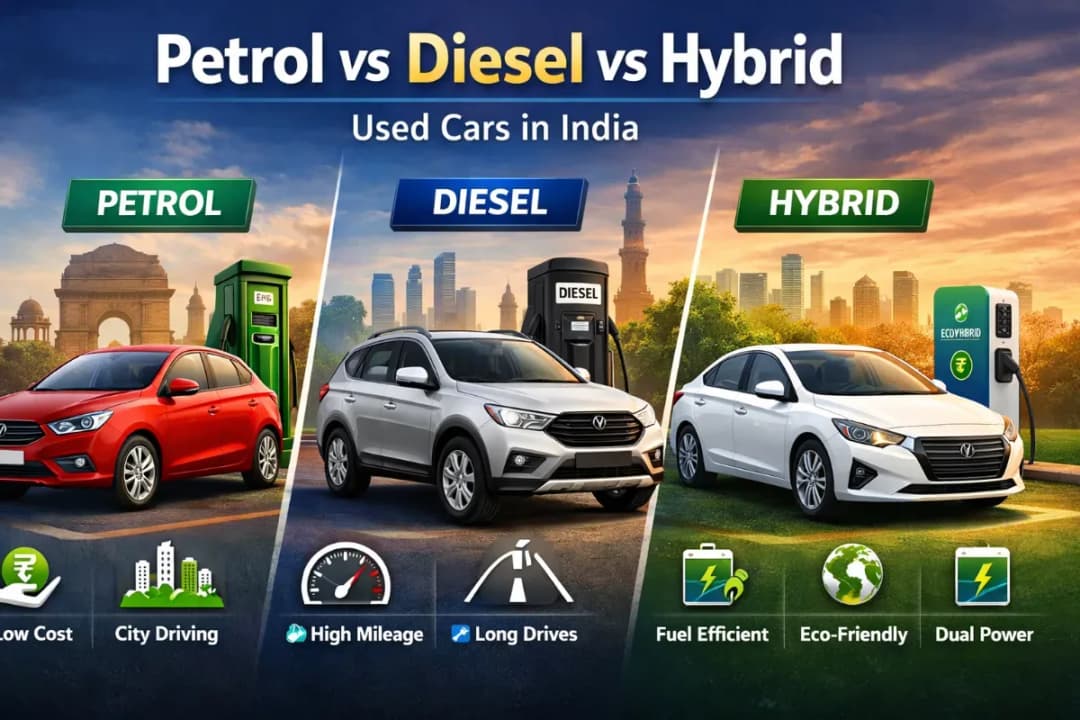
Petrol cars usually cost less to buy and feel smoother in traffic. Diesel cars offer better mileage and stronger low-end pull, which is useful for highways and long-distance use. Hybrids combine a petrol engine with an electric motor to improve fuel efficiency, especially in city conditions.
There is also a regulatory side. In Delhi-NCR, diesel cars older than 10 years and petrol cars older than 15 years face restrictions. That means the age and fuel type of a used car directly influence how long you can keep using it. If you ignore this, you might end up with a car whose usable life is shorter than expected.
Resale value also changes by fuel type. Diesel cars often hold value well in many segments because of mileage and durability. Petrol cars are easier to buy and easier to maintain, but they may depreciate faster. Hybrids are still developing their place in India’s used market, so resale value depends heavily on brand, model, and battery condition.
The right way to choose is simple. Start with your own usage. How many kilometers do you drive in a year. Is most of your driving in city traffic or on highways. How long do you plan to keep the car. Your answers will often tell you which fuel type fits best.
What is a Petrol Car?
How Petrol Cars Work
Petrol cars are the most familiar choice for Indian buyers. They use spark ignition, which means the engine burns a mixture of air and petrol using a spark plug. In practical terms, this leads to smoother performance, less vibration, and quieter operation.
Petrol engines are usually lighter than diesel engines. This helps with agility and makes petrol cars feel easier to drive in crowded cities. Acceleration is often more linear and refined, which is why many people prefer petrol cars for day-to-day urban use.
In the used car market, petrol vehicles are popular because they are usually cheaper to buy. They also tend to have lower servicing costs because the engine and related components are less complex. For first-time buyers, students, small families, or people with limited annual usage, a petrol car often feels like the safest and simplest option.
Still, petrol cars are not the best for everyone. Their biggest weakness is fuel efficiency, especially on long daily commutes. If you drive a lot, the running cost can become high over time.
Pros and Cons of Petrol Cars
The biggest strength of a petrol car is convenience. It is easy to drive, easy to maintain, and usually easy to buy. In traffic-heavy cities, petrol cars feel refined and less tiring. Clutches are often lighter, engine noise is lower, and the overall experience is more relaxed.
Maintenance is another strong advantage. Routine service is generally affordable. Parts such as spark plugs, filters, and engine components are widely available and less expensive than those in diesel cars. This makes petrol vehicles practical for buyers who want predictable maintenance bills.
The lower purchase price also matters. In the used market, petrol cars are often the most budget-friendly choice. That is helpful if you are buying your first car or want to avoid stretching your budget.
The downside is fuel economy. Petrol engines usually deliver lower mileage than diesel engines, especially in larger vehicles. If you cover a long distance every month, fuel spending will add up. Petrol cars also tend to have a weaker resale position in some segments, especially compared with diesel SUVs and sedans.
So petrol cars are best for buyers who want a lower upfront cost, lower maintenance, and mostly city-based driving.
What is a Diesel Car?
How Diesel Cars Work
Diesel cars use compression ignition. Instead of a spark plug, the engine compresses air to very high pressure and temperature, then injects diesel fuel, which ignites on its own. This engineering difference creates one major real-world benefit: torque.
Diesel engines produce stronger pulling power at lower speeds. That is why they feel more effortless on highways, on inclines, and with full passenger load. They are also more fuel-efficient because diesel contains more energy per litre and diesel engines are built to extract that energy well.
This is why diesel cars have traditionally been popular among long-distance users, taxi fleets, and buyers who spend a lot of time on highways. In the used market, diesel vehicles are often seen as durable workhorses that deliver better value for heavy usage.
But diesel cars are not as friendly in every situation. They are heavier, noisier, and more mechanically complex than petrol cars. In city traffic, they may feel less smooth. Newer diesel vehicles with advanced emission-control systems can also develop issues if mostly driven on short trips.
Pros and Cons of Diesel Cars
The main reason buyers choose diesel is running cost. Diesel cars usually offer better mileage than petrol versions of the same vehicle. For people driving 15,000 km or more per year, that difference can lead to substantial savings.
The second big advantage is highway performance. Diesel cars feel strong and stable on long drives. Overtaking is easier, hill driving is more effortless, and the engine feels less strained under load. This makes diesel a strong option for frequent travelers, intercity commuters, and SUV buyers.
Diesel vehicles also tend to retain resale value well in many cases, especially when they are in good condition and still have enough legal life left. Buyers often look for diesel cars in segments where fuel efficiency matters most.
Related Reading
The Manual Transmission is Dead. Get Over It.The trade-off is cost and complexity. Diesel cars usually cost more to buy, even in the used market. Servicing is also more expensive. Parts such as turbochargers, injectors, and emission-control components are not cheap. If neglected, repairs can become costly.
Another concern is regulation. In places like Delhi-NCR, diesel cars older than 10 years face restrictions. This can reduce their attractiveness in the used market and limit ownership duration.
Diesel makes the most sense when usage is high and travel is long-distance. It makes less sense for light city use.
What is a Hybrid Car?
Types of Hybrid Cars
A hybrid car combines a petrol engine with an electric motor. The idea is simple. Use the electric motor when possible to reduce fuel consumption, then let the petrol engine take over when needed. This improves efficiency and lowers emissions without requiring external charging like a fully electric car.
In India, hybrids are usually available in two forms: mild hybrids and strong hybrids. Mild hybrids assist the engine but do not drive the car on electric power alone for meaningful distances. Strong hybrids are more advanced. They can run on electric power at low speeds and in slow traffic, then switch between petrol and electric modes automatically.
A key feature of hybrids is regenerative braking. When you slow down or brake, some of that lost energy is captured and sent back to the battery. This improves efficiency, especially in city traffic where braking is frequent.
For Indian buyers, hybrids are especially relevant in urban environments. They can deliver strong fuel economy in stop-and-go traffic, where petrol cars are less efficient and diesel engines are not at their best.
Pros and Cons of Hybrid Cars
The biggest strength of a hybrid is fuel efficiency in city driving. In slow-moving urban conditions, the electric motor reduces fuel usage significantly. Some strong hybrids can match or even beat diesel cars for city mileage.
The second advantage is lower emissions. Hybrids are cleaner than regular petrol and diesel cars, which matters more as environmental concerns and emission norms become stricter. They also feel refined to drive. Electric assistance makes low-speed movement smooth and quiet.
Hybrids are a good choice for buyers who want better city efficiency without moving fully to an electric car. They also feel more future-ready than traditional fuel-only vehicles.
Their biggest weakness is cost. Even in the used market, hybrids usually have a higher purchase price. Availability is also lower because the segment is still relatively small.
Battery health is the biggest issue in a used hybrid. Hybrid batteries are built to last many years, but their condition needs to be checked carefully before purchase. A degraded battery can reduce efficiency, and replacement can be expensive. Service history matters a lot here.
Resale value is still evolving. In some models it is strong because demand is growing. In others, buyers remain cautious because of battery concerns.
A hybrid suits buyers who want better city mileage, lower emissions, and are ready to pay more upfront for long-term efficiency.
Cost Comparison: Purchase Price, Depreciation, and Running Cost
Petrol cars are usually the cheapest to buy in the used market. That makes them attractive to budget-focused buyers. The downside is faster depreciation in many segments, especially where diesel demand remains strong.
Diesel cars usually cost more upfront than petrol cars, but they often retain value better if they are well-maintained and have useful legal life left. Their stronger resale comes from their mileage advantage and long-distance appeal.
Hybrid cars usually have the highest purchase price among the three. Depreciation is less predictable because the market is newer. Some hybrids hold value well because demand is rising. Others face buyer hesitation due to battery-related concerns.
Running cost changes the picture further. Petrol cars usually offer moderate mileage and therefore higher monthly fuel expense for heavy users. Diesel cars offer better mileage and lower running cost for long-distance driving. Hybrids offer very strong city efficiency and can significantly reduce monthly fuel spend if most driving is urban.
So the cheapest car to buy is not always the cheapest car to own. You need to compare both purchase cost and usage pattern.
Maintenance and Longevity
Service Costs and Spare Parts
Maintenance is where petrol cars have a clear edge in simplicity. Their engines are less complex, servicing is cheaper, and spare parts are widely available. For buyers who want low-maintenance ownership, petrol is a safe bet.
Diesel cars cost more to maintain. They have more complex systems and expensive components. A well-maintained diesel can be highly reliable, but a neglected one can become an expensive problem. Used diesel cars therefore need careful inspection and complete service records.
Hybrids have two systems working together, which adds complexity. Routine maintenance is not always dramatically expensive, but hybrid-specific issues, especially battery-related ones, can be costly. This makes pre-purchase inspection even more important.
Engine Lifespan and Reliability
In terms of lifespan, diesel engines are often considered the most durable when used properly and maintained well. They are built for high compression and can handle heavy usage over long distances. Petrol engines are also reliable and can last a long time, especially when used in city conditions and serviced regularly. Hybrids depend not only on engine condition but also on battery health. A strong service record becomes essential.
Best Choice Based on Driving Needs
Related Reading
Women Behind the Wheel: Changing Indian AttitudesCity Driving vs Highway Driving
If your driving is mainly in the city, petrol and hybrid cars are the strongest options. Petrol works well for moderate use and a lower budget. Hybrid is even better in stop-and-go traffic if you are willing to spend more upfront.
If your driving is mostly on highways or you travel long distances every week, diesel is usually the best financial and performance choice. Its better mileage and stronger torque make it ideal for this kind of usage.
Long-Term Ownership vs Short-Term Use
If your annual running is low, a petrol car often makes the most sense because the lower upfront and maintenance cost outweigh fuel economy concerns. If your annual running is high, diesel becomes more attractive. If your driving is mostly urban and you want efficiency with lower emissions, hybrid deserves serious consideration.
Long-term ownership also matters. If you plan to keep the car for many years and drive a lot, diesel or hybrid can offer better value. If you want short-term ownership or occasional use, petrol is often the easiest decision.
Environmental Impact and Future Regulations
Environmental policy is becoming a bigger factor in India. Diesel engines are efficient but produce more nitrogen oxides and particulates, which is why they face stricter regulation in some regions. Petrol cars are cleaner than diesel in some respects but still rely fully on fossil fuel. Hybrids reduce fuel use and emissions, making them more aligned with the direction the market is moving.
Government policy, local restrictions, and resale trends are likely to increasingly favor cleaner technologies. That does not mean diesel has no place, but it does mean buyers need to think ahead, especially when buying an older used vehicle.
Conclusion
There is no single best fuel type for every used car buyer in India. Petrol, diesel, and hybrid each make sense in different situations.
Choose petrol if you want a lower purchase price, lower maintenance cost, and mostly city or low annual usage. Choose diesel if you drive long distances, want better mileage, and need strong highway performance. Choose hybrid if your driving is mostly urban, you want better fuel efficiency and lower emissions, and you are comfortable paying more upfront.
The smartest used car purchase is not the one with the most popular badge or the lowest asking price. It is the one that matches your driving pattern, budget, city regulations, and long-term plans. If you get the fuel type right, the rest of your ownership experience becomes much easier.
FAQs
1. Which is best for city driving in India?
Petrol and hybrid are usually best for city driving. Hybrid has the edge in traffic-heavy conditions because it saves more fuel at low speeds.
2. Is diesel still worth buying in the used market?
Yes, but mainly for buyers with high annual running and regular highway use. You should also check local regulations before buying.
3. Are hybrid cars safe to buy used?
Yes, if battery health, service history, and overall condition are checked properly. Without that, the risk increases.
4. Which fuel type has the lowest maintenance cost?
Petrol usually has the lowest maintenance cost because the engine is simpler and parts are cheaper.
5. Which has the best resale value?
Diesel often has strong resale value in many segments, but this depends on vehicle age, condition, and regional restrictions. Hybrid resale is improving, while petrol remains the easiest entry-level option.