
Quick Summary: India's passenger vehicle retail crossed 47 lakh units in FY2026, with the compact SUV segment alone selling 12.9 lakh units. The Tata Nexon sold 2.16 lakh units with 32% year-on-year growth. Mahindra's Thar and Thar Roxx feature in the top 10 SUVs nationally. The structural question this data raises: are cities like Ghaziabad, Nashik, Lucknow, and Jaipur quietly becoming stronger SUV resale markets than the metro-first assumption suggests? This research-led perspective examines the evidence, the buyer profiles, and what the data can and cannot prove.
The conventional wisdom around used car resale in India has long pointed at the same places. Delhi. Mumbai. Bengaluru. The assumption has been that resale power concentrates where population and money concentrate.
FY2026 data is beginning to challenge that assumption. India's passenger vehicle retail crossed 47.05 lakh units in FY2026 — the first time it has cleared that mark — with demand spreading visibly beyond the metros. Cities like Ghaziabad, Nashik, Lucknow, Jaipur, and Coimbatore are not just growing faster in new-car penetration. They are developing the conditions that tend to precede stronger used-car markets. The question worth asking seriously: is Tier-2 India quietly becoming one of the most interesting SUV resale environments in the country?
Why FY2026 Matters More Than Just a Headline Sales Record
The composition of FY2026's growth matters as much as the number itself — and the segment-level data tells a story with direct resale implications.The sub-4 metre SUV segment — India's highest-volume body style category — reached 12.9 lakh units in FY2026, growing 6.3% year on year. The Tata Nexon sold 2,16,054 units, up 32% from the previous year, reclaiming the title of India's best-selling SUV for the fourth time. The Hyundai Creta posted its highest-ever annual sales at over 2 lakh units. The Mahindra Scorpio N, Thar, and Thar Roxx all feature in the top 10 SUVs nationally.
This matters for the resale market because volume creates liquidity. When a product sells at scale across geographies, second-owner confidence improves, financing becomes easier, and the pool of buyers who recognise and want the product grows wider. The Nexon crossed the cumulative one-million-unit sales milestone in February 2026 — a number that signals deep brand familiarity across the country, including in cities far outside the metros. A widely sold, widely recognised SUV in Tier-2 markets does not need buyer education. It only needs supply — which is where the resale opportunity begins to form.
The Real Hypothesis: Why Tier-2 Cities Could Outperform on SUV Resale
Tier-2 cities occupy a commercially interesting position — sitting between metro aspiration and non-metro practicality, and moving fast in ways that create genuine resale conditions.Rising incomes, infrastructure investment, expanding financing networks, and the aspirational pull of metro lifestyles have accelerated upgrading cycles. Buyers who owned an entry hatchback five years ago are now looking at compact SUVs. The structural case for stronger Tier-2 SUV resale rests on several converging factors: more SUVs entering and completing their first ownership cycle in these cities; buyers who are more price-sensitive than metro buyers, making used SUV demand genuinely deep; and car ownership carrying visible social weight in smaller cities, where an SUV — even pre-owned — signals status more clearly than a sedan or hatchback of equal value.
What Makes an SUV Resale-Friendly in a Tier-2 Indian Market
Not all SUVs age equally in Tier-2 markets — the ones that hold resale strength share specific qualities that are worth understanding before buying or selling.Broad brand recognition, a clear use case for Indian roads, easy financing at the used-car price point, strong service network coverage including in smaller cities, and powertrains that are familiar and maintainable locally all matter. Diesel relevance is higher in Tier-2 markets than in most metros. A diesel SUV that makes economic sense at 1,500 to 2,000 km per month holds stronger second-owner appeal, because fuel economics become a purchase justification, not just a preference.
Mid-spec variants tend to move faster in Tier-2 resale than top-spec ones, because the price difference between a used top-spec and a new mid-spec often becomes uncomfortably narrow for buyers. The sweet spot is a well-maintained, mid-specification SUV from a widely known brand, in a popular colour, under five years old and under 70,000 km.
Compact SUVs: The Broadest and Most Scalable Resale Story
With 12.9 lakh units sold in FY2026 and the Tata Nexon's 2.16 lakh unit milestone, the compact SUV segment's resale liquidity is now wider and deeper than any other body style category in India.The Nexon's powertrain lineup spanning petrol, diesel, CNG, and electric means resale demand exists across fuel preference types — unusual and valuable for a used-car platform. The Maruti Brezza, Hyundai Venue, and Kia Sonet each also posted strong volumes, reinforcing how broad and multi-brand this buyer interest has become. In Tier-2 markets specifically, compact SUVs carry a particular advantage. Their sub-4 metre length makes them practical in cities with narrower roads. Their price range sits comfortably within the financing envelope of the Tier-2 buyer who is upgrading. And their family utility — five adults, reasonable boot space, SUV height — addresses real use cases, not lifestyle aspirations alone.
Lifestyle SUVs: Emotional Demand Changes the Resale Equation
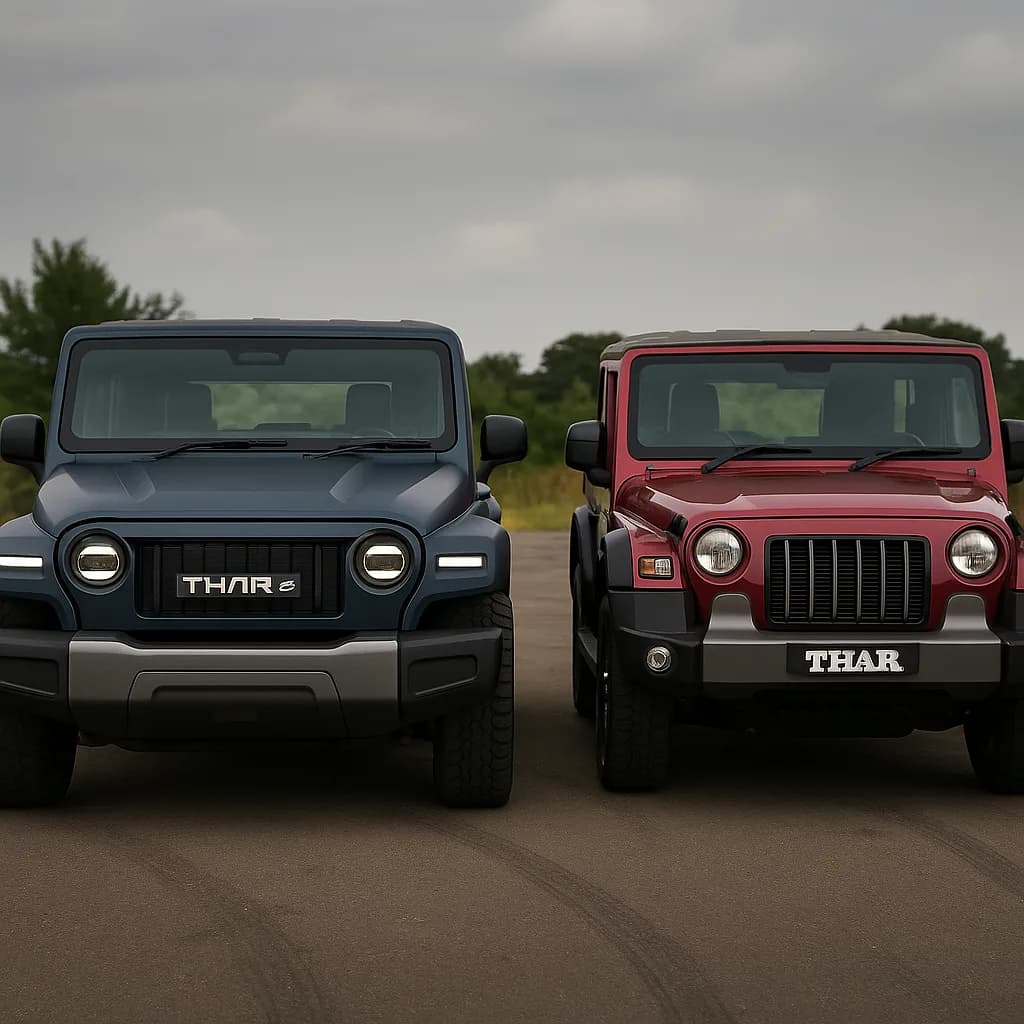
The Mahindra Thar and Thar Roxx have created genuine emotional demand broader than any enthusiast community — and that emotional pull behaves differently from practical resale value.Mahindra's Thar registered 1,26,261 units in FY2026, placing it firmly in India's top 10 SUVs. The Thar Roxx's five-door format significantly expanded the product's appeal to family buyers in non-metro markets who wanted presence and identity without sacrificing practicality. In Tier-2 cities, lifestyle SUVs carry visible social value that translates into genuine second-owner demand from buyers who want that signal without paying new-car prices.
The nuance: lifestyle SUVs are time-sensitive resale plays. Their emotional premium holds strongest when the vehicle feels current — clean, low on usage, not outdated by a new variant. Hold a Thar too long, let the next variant capture attention, or sell one with high mileage and visible wear, and the aspiration premium fades quickly. These vehicles reward early resale discipline.
Why Ghaziabad, Nashik, Lucknow, Jaipur, and Similar Cities Matter More Than People Think
These cities create the conditions — aspiration, affordability, active upgrading, and growing used SUV supply — that tend to produce stronger resale dynamics than the metro-only assumption allows for.Ghaziabad consistently appears in the top tiers of Vahan registration data for Uttar Pradesh. Its proximity to Delhi means buyer aspirations are shaped by metro trends, but its pricing dynamics and inventory availability differ — creating a market where a well-maintained compact SUV priced correctly can attract buyers priced out of the Delhi used-car market but wanting an equivalent product. Nashik has emerged as a significant automotive hub with consistent passenger vehicle growth supported by employment and income levels that support both first and second SUV ownership cycles.
Attributing specific resale profit percentages to these cities without verified transaction-level data would be speculative. What can be said, based on national FY2026 data, is that these cities create the structural conditions that tend to produce stronger resale dynamics than cities at either end of the spectrum.
The Buyer Profiles Driving Tier-2 SUV Resale Demand
The demand for used SUVs in Tier-2 India is driven by identifiable buyer types whose motivations are practical, aspirational, and deeply Indian.- Young salaried professionals: Buying their first aspirational car, often choosing a used compact SUV over a new hatchback because the monthly payment difference is marginal but the perceived value gap is significant
- Small business owners: Driving 2,000 km or more a month and needing a practical, durable, diesel-friendly vehicle that makes economic sense on actual running costs
- Upgrading families: Moving from sedans or ageing hatchbacks, prioritising height, boot space, and the perception of safety that an SUV body style carries
- Status-conscious buyers: Who want a visible life upgrade without paying full new-car cost, for whom a well-maintained used SUV carries real social value in smaller cities
These buyers share a common trait: they are EMI-sensitive but aspiration-led. They are not buying cheap — they are buying smart, and what they consider smart is often a two to three year old compact SUV with a clean service history, low mileage, and a recognisable name.
What the Data Can and Cannot Prove
The honest framing: the structural case for Tier-2 SUV resale is well-supported by FY2026 data — but specific city-level profit projections are not yet backed by publicly available used-car transaction data.National FY2026 retail figures and segment-level sales data strongly support the broader argument: India's SUV market is growing structurally, compact SUVs dominate volume, Tier-2 demand is widening, and buyer aspiration for SUV products is not limited to metros. What the publicly available data cannot prove is specific city-level resale retention rates, exact per-unit flip profits, or precise price differentials between metro and Tier-2 used SUV transactions. Those conclusions require verified used-car transaction data at city resolution. The opportunity is directionally real. The exact dimensions require more localised intelligence.
How to Read Tier-2 SUV Resale Opportunities More Intelligently
A practical framework for assessing resale opportunity in a Tier-2 market should examine several factors that play out differently than they do in a metro.- Model liquidity: Does this product sell at national volume, making second-owner buyers familiar with it?
- Fuel relevance: Is petrol, diesel, or CNG more aligned with how buyers in this specific city actually drive?
- Service network density: Is authorised servicing accessible in or near the city, which affects buyer confidence?
- Variant positioning: Does this trim level sit at a price point where used demand from upgraders is strongest?
- Launch cycle awareness: Has a facelift or next-generation model been announced that could redirect aspirational demand toward newer stock?
The Real Risks Behind the Goldmine Narrative
The biggest resale error is confusing strong new-car sales with automatic used-car profit — they are not the same thing, and misreading this is where most resale strategies fail.Oversupply of a particular variant, a price correction following a facelift, or a shift in local buyer preference can compress resale margins quickly. Holding too long is the second most common mistake. In a market where new models arrive frequently and buyers are aspirational, a compact SUV that feels current at three years old can feel dated at five. Maintenance neglect, high mileage, unusual colour choices, and aftermarket modifications all reduce the buyer pool and consequently the achievable price. Resale success is not about owning an SUV. It is about owning the right SUV, maintained correctly, sold at the right point in the cycle, in a market where local demand is genuinely active.
NXCar Perspective: The Smart Opportunity Is Not Every SUV. It Is the Right SUV in the Right Market Cycle.
India's used-car opportunity is no longer only a metro story — and FY2026 data provides the strongest structural case yet for taking Tier-2 SUV resale seriously.Compact SUVs look structurally strongest for Tier-2 resale: broad recognition, multi-fuel options, easy financing, practical road suitability, and a buyer pool that spans both upgraders and aspirational first-time SUV owners. Lifestyle SUVs can outperform in narrower windows where the emotional premium is fresh and the product still feels current. Both categories reward timing, discipline, and market reading — not speculation. The next interesting resale battleground in India is likely not in cities where the used-car market is already deep and competitive. It is in cities where new-car penetration is rising, buyer profiles are upgrading rapidly, and the supply of well-maintained used SUVs has not yet caught up with the demand that is quietly forming.
Conclusion
India's automotive story has always started in the metros and spread outward — FY2026 suggests the spread has become substantial enough that Tier-2 markets deserve to be read on their own terms.The opportunity in Tier-2 SUV resale is real. It is not uniform, it is not guaranteed, and it is not accessible without product discipline, timing awareness, and local market intelligence. But for buyers and sellers who are willing to think about where aspiration, affordability, and demand are quietly compounding — rather than chasing markets everyone else is already watching — the signal in the FY2026 data is worth reading seriously.
FAQs
Why are SUVs reselling strongly in Tier-2 India?
Because aspiration, affordability ladders, and infrastructure improvements are driving faster upgrading cycles in non-metro cities. Buyers who could not previously access new compact SUVs are now active in the used market, creating real second-owner demand for products they recognise and want.
Are compact SUVs better resale bets than sedans in smaller cities?
Generally yes. SUVs offer higher ground clearance suitable for varied road conditions, carry stronger aspirational value relative to their price, attract broader buyer profiles, and currently dominate new-car sales — which means second-owner familiarity is deeper and buyer pools are wider.
Do lifestyle SUVs like the Thar hold value well in resale?
They can, but the window is narrower than for practical compact SUVs. Lifestyle SUVs hold value best when they still feel current, are low on mileage, and are sold before a newer variant captures aspirational attention. Timing discipline matters significantly more here than in the compact SUV segment.
What matters more for resale in Tier-2 markets — brand or body style?
Both matter, and they work together. A recognised brand in a practical body style — a Nexon, Brezza, or Creta in compact SUV form — typically outperforms either a strong brand in an unpopular body style or a popular body style from a brand with weak service coverage in that city.
How should buyers judge whether a city has strong resale demand?
Look at new-car registration growth as a leading indicator of future used-car supply. Assess income and upgrading trends for buyer demand signals. Check service network density for the brands being considered. And examine local fuel preference — a diesel SUV in a city where diesel suits high-mileage driving patterns will find buyers more readily than one in a city dominated by short urban petrol trips.