Quick Summary: Tyre wear patterns are one of the most honest sources of information about a used car's history — and most Indian buyers walk straight past them. Uneven wear, cupping, edge feathering, and mismatched tread depths across the four corners can reveal alignment problems, worn suspension, and accident history that sellers never volunteer. Here is how to read what the tyres are telling you, calculate the real cost, and use your findings to negotiate smarter.
Most used car buyers in India walk around a car, glance at the tyres, and move on. Maybe they press a thumb into the tread to check if it looks worn. That is about it.
What they are missing is one of the most honest sources of information about a used car's entire history — one that no seller can easily fake, polish over, or hide with a fresh vacuum.
Tyre wear patterns record how a car was driven, how it was maintained, and whether it has been through an accident that was never disclosed. Learning to read them takes five minutes and costs nothing. What it saves you can be significant.
Why Tyres Never Lie
A seller can clean the engine bay, apply touch-up paint, and put new floor mats in the cabin. They cannot reverse what months or years of driving have written into the rubber.Each tyre's wear pattern is a record. Uneven wear across the tread surface, cupping along the circumference, feathering on the tread blocks, differences between the four corners — all of these tell you something specific about the car's mechanical condition and ownership history.
In India, where city driving involves constant braking, speed breakers, potholes, and summer heat that accelerates rubber deterioration, tyre wear happens faster and speaks louder than in gentler driving conditions. That makes this inspection even more valuable here.
The Basic Inspection: What to Look for on Each Tyre
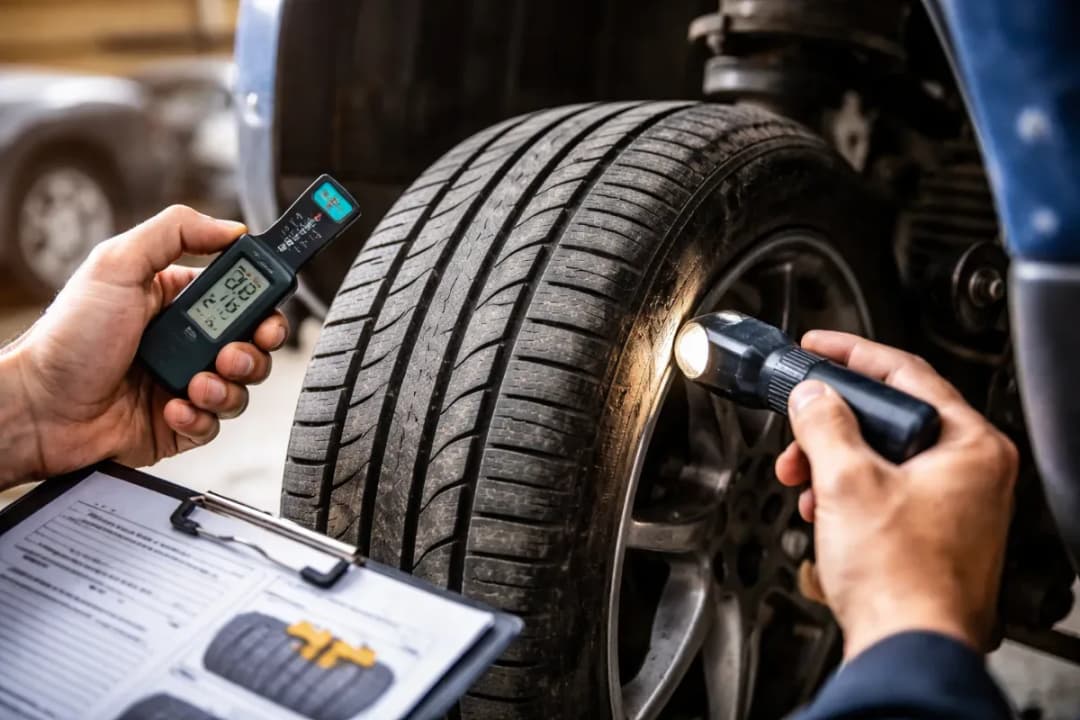
Before measuring anything, run your hand across the tread surface of each tyre from the inside edge to the outside edge. Then run your hand around the circumference. You are feeling for two things: side-to-side unevenness and high-low spots around the tyre's surface.Edge wear — the alignment warning
If one edge of the tyre is noticeably more worn than the other, the wheel alignment is off. This happens after hitting a deep pothole, after an accident, or from suspension components that have worn and shifted wheel geometry.
Inner edge wear — where the inside of the tyre is worn significantly more than the outside — points to excessive negative camber. This is often caused by worn suspension components or, in more serious cases, bent structural elements from an unreported impact.
Outer edge wear suggests the opposite alignment issue, or a car that was driven aggressively through corners over a long period.
In India's pothole-heavy roads, alignment issues are common. The important question is whether the problem was diagnosed and fixed, or whether it was left to continue eating through rubber and suspension components.
Centre wear
When the centre of the tread is more worn than the edges, the tyre has been running over-inflated for an extended period. This tells you the previous owner did not monitor tyre pressures regularly — a basic maintenance habit. If they skipped that, they likely skipped other scheduled maintenance too.
Cupping and scalloping — the suspension tell
Run your hand around the full circumference of each tyre and feel for dips and raised sections — a wave-like pattern in the tread. This is called cupping or scalloping, and it is caused by worn shock absorbers or struts that can no longer control the tyre's bounce against the road.
In India, shock absorbers take punishment daily from speed breakers and broken road surfaces. Cupping on a used car's tyres tells you the shocks were worn and the previous owner either did not notice or chose not to fix them. Replacing shock absorbers on a typical Indian hatchback or sedan costs between Rs 4,000 and Rs 15,000 per pair — and that cost should come out of your offer price.
Measuring Tread Depth Across All Four Corners
Most buyers check whether tread depth clears the minimum. The smarter approach is to measure and compare across all four tyres.A basic tread depth gauge costs Rs 200 to Rs 500 at any auto accessories shop. Use it to measure each tyre at three points across the width — inside edge, centre, and outside edge. Take measurements at two or three positions around the circumference as well.
What you are looking for:
- Even measurements within a tyre suggest the suspension and alignment are healthy on that corner
- A difference of more than 2mm between the inner and outer edge of the same tyre indicates an alignment problem
- Significant differences in overall tread depth between the four tyres — more than 3mm variation — indicate uneven wear that needs explanation
A car where three tyres have 3mm of tread and one tyre has 7mm tells you something happened to that one corner recently. Maybe a puncture. Maybe an accident. Either way, ask directly and watch how the seller responds.
- Tyres below 2mm need immediate replacement
- Budget Rs 2,500 to Rs 5,000 per tyre for a typical Indian hatchback or sedan
- Budget Rs 5,000 to Rs 10,000 per tyre for larger SUVs or premium cars
- A full set on a Maruti Swift, Honda City, or Hyundai Creta at that condition means Rs 10,000 to Rs 40,000 in immediate expense, depending on the model and tyre brand
- Add Rs 500 to Rs 1,500 for a four-wheel alignment if edge wear is present
- This total immediate tyre-related cost should be deducted from your offer
What Mismatched Tyres Tell You
Walk around the car and note the brand on each tyre. Four matching tyres from the same brand suggest an owner who planned ahead — when they replaced tyres, they replaced the set properly.Mixed brands, or budget-brand tyres on a car that was otherwise premium, suggest a pattern of reactive, minimum-cost maintenance. Tyres were replaced one at a time as they failed, with whatever was cheapest available. That approach to tyres usually reflects the same approach to engine oil, brake pads, and coolant.
This is not a dealbreaker. But it is a signal about ownership discipline that is worth weighing when you evaluate the car as a whole.
Using Tyre Wear as Negotiation Leverage
This is where the inspection becomes financially useful.Once you have measured and documented the tyre condition — photos of wear patterns, tread depth readings, notes on any cupping or edge wear — you have specific, measurable findings to bring to the negotiation.
Vague complaints about a car feeling old get dismissed. A documented finding that three tyres are at 2mm, one tyre has significant inner edge wear indicating alignment problems, and the rear tyres show early cupping — with a written estimate for replacement and alignment — is a different conversation entirely.
Present the numbers. Ask for a corresponding reduction in price, or ask that the tyres be replaced and the alignment corrected before handover. Most sellers will engage with specific documented findings. Those who refuse entirely are also giving you useful information — either the car is worth less than they are asking, or there are other issues they are not comfortable discussing.
A Quick Reference for the Inspection
Before finalising any used car purchase, run through this on every tyre:- Feel across the tread width for edge-to-edge unevenness
- Feel around the circumference for cupping or scalloping
- Measure tread depth at the inner edge, centre, and outer edge
- Compare overall depth across all four tyres
- Note the brand on each tyre and check for mismatches
- Check sidewalls for cracks, bulges, or any repairs
The whole process takes about ten minutes per car. On a car with hidden tyre and suspension issues, those ten minutes can save you Rs 20,000 to Rs 50,000.
The Tyre Is Where Everything Connects
Every force that acts on a car — braking, cornering, absorbing a pothole, carrying a full load — passes through the four contact patches where the tyres touch the road.The condition of those contact patches, and the wear patterns left behind, reflect everything the car has been through. A seller can tell you the car was well maintained. The tyres will confirm it or contradict it.
Take the ten minutes. Bring a gauge. Take photos. Calculate the cost. Use the findings to make a smarter decision — on price, on whether to proceed, or on whether this particular car is worth your money at all. Nxcar's verification and inspection process includes tyre and suspension assessment as a core part of evaluating any used vehicle — because what you can measure, you can negotiate with confidence.
FAQs
What does inner edge wear on the front tyres of a used car mean?
It indicates a wheel alignment problem, often caused by worn suspension components or, in more serious cases, structural damage from an unreported accident. The car needs alignment work, and the suspension should be inspected for worn ball joints or control arm bushings before purchase.
How do I check tyre wear without any tools?
Run your hand from the inside edge to the outside edge of each tyre. Uneven resistance indicates edge wear. Then run your hand around the circumference — dips and raised sections indicate cupping from worn shocks. A basic tread depth gauge costs Rs 200 to Rs 500 and makes the inspection much more precise.
Can tyre wear indicate that a car has been in an accident?
Yes. A single tyre that is significantly newer than the other three, or heavily mismatched wear on one side of the car, can indicate post-accident tyre replacement without addressing underlying structural or suspension damage. Always ask for an explanation and consider an independent inspection.
How much should I deduct from my offer if tyres need immediate replacement?
Budget Rs 2,500 to Rs 5,000 per tyre for standard hatchbacks and sedans, and Rs 5,000 to Rs 10,000 for larger SUVs or premium vehicles. Add Rs 500 to Rs 1,500 for alignment if edge wear is present. Deduct the total from your offer.
Is it a problem if a used car has four different tyre brands?
It suggests reactive, minimum-cost maintenance — tyres replaced one at a time as they failed rather than as a planned set. This is worth noting as a broader signal about how the car was maintained overall, even if it is not a dealbreaker on its own.