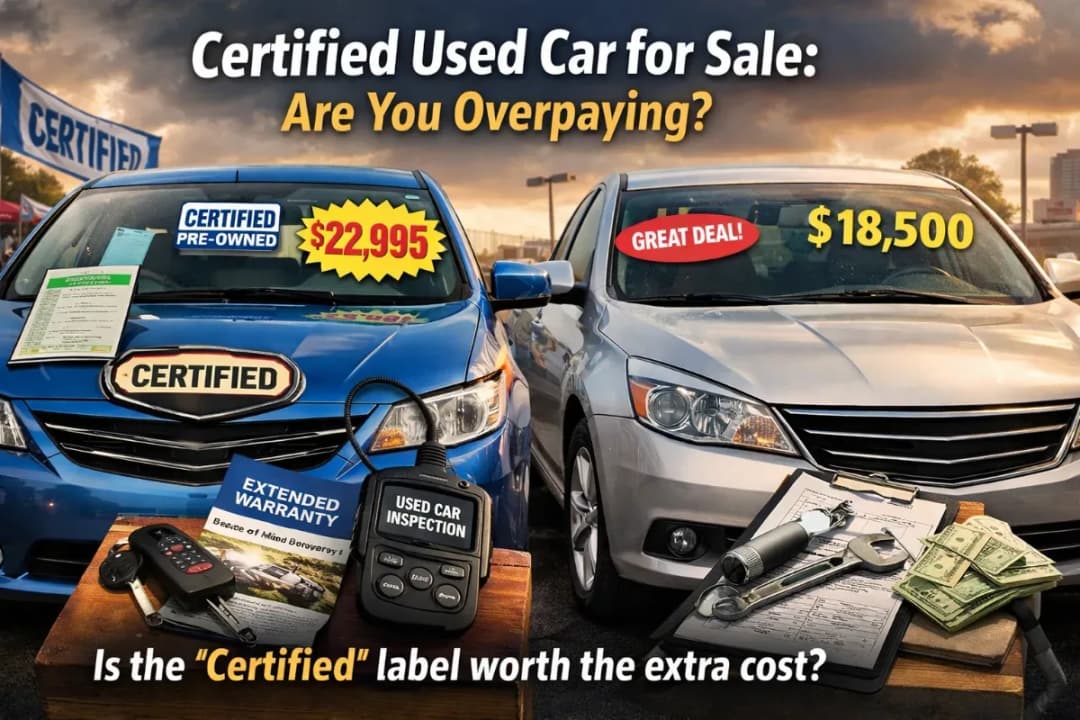
A certified used car sounds safer, smarter, and worth the premium. But what does certification actually include in India, how much does it add to the price, and when does that extra cost genuinely protect you — versus when does it simply pad dealer margins? This guide gives you the honest answer so you can decide for yourself.
At nxcar, we help buyers cut through the marketing language around certified pre-owned programmes and evaluate whether the certification premium delivers real value for their specific situation. The short answer is: it depends. CPO vehicles in India typically cost 8–15% more than equivalent non-certified used cars. You are paying for a multi-point inspection, a limited extended warranty, and manufacturer backing. Whether that trade-off makes sense for you depends on the car you are buying, the brand's reliability record, and how much mechanical confidence you have going in.
Not all certifications are created equal. A Maruti True Value certification and a BMW Premium Selection certification are very different products at very different price points with very different risk profiles behind them. This guide helps you understand exactly what you are buying — and when you should walk past the badge entirely.
Understanding Certified Pre-Owned Programmes in India
Certified Pre-Owned programmes in India are manufacturer-backed initiatives that inspect used vehicles against a defined checklist, provide a limited extended warranty, and carry the manufacturer's brand name as a quality assurance. Unlike regular used cars, CPO vehicles must meet specific age and mileage criteria set by the manufacturer.
Every major manufacturer operating in India runs some form of CPO programme. The standards, warranty terms, and price premiums vary considerably between brands and segments — understanding these differences is the foundation of any CPO evaluation.
Manufacturer CPO vs. Dealer Certification: A Critical Distinction
The most important distinction in the Indian used car market is between manufacturer-backed CPO programmes and dealer-issued certifications.
Manufacturer CPO programmes are backed by the original automaker and operate through their authorised dealer network. In India, these include:
-
Maruti Suzuki True Value: Vehicles up to 5 years old, under 75,000 km, sold through authorised True Value outlets with a 1-year warranty.
-
Hyundai H Promise: Vehicles up to 7 years old, inspected at authorised Hyundai service centres, 1-year warranty with roadside assistance.
-
Toyota U Trust: Toyota vehicles up to 6 years old, 160-point inspection at authorised Toyota dealers, 1-year or 20,000 km warranty.
-
Honda Auto Terrace: Honda vehicles up to 7 years old, inspected at authorised service centres, 1-year warranty.
-
Mahindra First Choice: Multi-brand used cars with graded condition ratings, limited warranty options, wide network coverage.
-
BMW Premium Selection / Mercedes-Benz Certified: Luxury segment programmes with more comprehensive inspections and longer warranty coverage, reflecting the higher repair cost exposure these brands carry.
Dealer certifications — issued by independent used car dealers or multi-brand outlets — are an entirely different matter. One dealer's "certified" label may represent a thorough 150-point inspection by a qualified technician; another's may mean little more than a wash and a sticker. Without a manufacturer's name behind the certification, the standard is only as reliable as the dealer's reputation. Treat these with significant scepticism and verify every claim independently.
What Is Actually Inspected During Manufacturer CPO Certification
Manufacturer CPO inspections in India typically cover the following systems:
-
Powertrain: Engine performance, oil condition, coolant, transmission operation, clutch condition (manual), drivetrain components
-
Safety systems: Brakes, airbag warning light status, seat belt condition and pretensioner function, ABS
-
Electrical: Battery, alternator, all lighting, air conditioning, infotainment
-
Structural: Chassis inspection, suspension components, steering
-
Interior and exterior: Cosmetic condition, paint, glass, tyres
The honest limitation: inspection quality varies with the technician and the time allocated. Most CPO inspections give a technician 2–3 hours and a checklist. This reliably catches obvious problems — worn brakes, fluid leaks, dead batteries, clear accident damage. It less reliably catches intermittent electrical faults, early-stage transmission issues, and problems that only manifest after extended driving. The warranty is the safety net for what the inspection misses.
The Real Cost Breakdown: What You Are Actually Paying
CPO vehicles in India typically cost 8–15% more than equivalent non-certified used cars of the same model, year, and mileage. On a car priced at ₹8 lakh, that is ₹64,000–1,20,000 extra. This premium covers inspection costs, warranty reserves, and reconditioning — but also includes dealer margin that is often at least partially negotiable.
CPO Price Premium by Segment
| Segment | Non-Certified Average | CPO Average | Premium Amount | Premium % |
|---|---|---|---|---|
| Hatchback (Swift, i20, Baleno) | ₹4.5–6.5 lakh | ₹5.0–7.2 lakh | ₹50,000–70,000 | 8–11% |
| Compact Sedan (Dzire, Amaze, City) | ₹5.5–9.0 lakh | ₹6.2–10.2 lakh | ₹70,000–1,20,000 | 10–13% |
| Mid-size SUV (Creta, Seltos, Taigun) | ₹9.0–16 lakh | ₹10.2–18.2 lakh | ₹1.2–2.2 lakh | 12–14% |
| Luxury (BMW 3 Series, Mercedes C-Class) | ₹18–35 lakh | ₹21–40 lakh | ₹3–5 lakh | 13–16% |
Luxury vehicles carry the highest percentage premiums — and the strongest justification for them. A single out-of-warranty repair on a BMW or Mercedes in India can run ₹1.5–4 lakh. The CPO warranty's value scales directly with the cost of what it is protecting against.
Additional Fees That Inflate the Total
The CPO vehicle price is not the final number. Watch for these add-ons when dealing with authorised dealers:
-
Certification or reconditioning fee: Sometimes charged as a separate line item — ₹8,000–25,000 depending on the programme. Ask whether this is already included in the vehicle price.
-
Extended warranty upsell: Dealers frequently offer additional warranty coverage beyond the CPO programme — ₹15,000–45,000. Evaluate this only after understanding what the CPO warranty already covers.
-
Accessories packages: Floor mats, seat covers, and dashboard accessories bundled at inflated prices. These can always be purchased separately for less.
-
Documentation and RTO transfer charges: Verify these against published government rates — overcharging on mandatory fees is common across the industry.
Financing: Where CPO Can Offer Genuine Advantage
Some manufacturer CPO programmes in India — particularly in the luxury segment — offer subsidised financing rates through their captive finance arms (BMW Financial Services, Mercedes-Benz Financial, etc.). These can be 1–2% below standard used car loan rates from banks.
On a ₹15 lakh loan over 5 years, a 1.5% rate difference saves approximately ₹60,000 in interest over the loan tenure — which can partially or fully offset the CPO price premium depending on the vehicle. Always compare the total cost of ownership, not just the sticker price.
Three-Year Ownership Cost Comparison
| Cost Component | CPO Vehicle (₹10 lakh, Hyundai Creta) | Non-Certified Used (₹8.8 lakh, same model) |
|---|---|---|
| Purchase price | ₹10,00,000 | ₹8,80,000 |
| Loan interest | ₹2,15,000 (8.5% used car rate) | ₹2,00,000 (9.5% standard rate) |
| Maintenance | ₹25,000 (under warranty) | ₹45,000 |
| Unexpected repairs | ₹0 (covered under warranty) | ₹60,000–1,50,000 |
| Total estimated 3-year cost | ₹12,40,000 | ₹11,85,000–12,75,000 |
In this scenario the CPO and non-certified vehicles sit at comparable three-year costs — with the non-certified option cheaper if the car runs well, and the CPO cheaper if it needs significant repair work. This is the fundamental trade-off: you are paying the CPO premium to transfer repair risk to the manufacturer rather than carrying it yourself.
What You Are Actually Getting for the Premium
The CPO premium buys risk reduction, not perfection. You are paying for an inspection that catches most obvious problems, warranty coverage against expensive repairs, and manufacturer accountability if disputes arise. The value of this depends entirely on the complexity of the specific vehicle and your own mechanical confidence.
The Multi-Point Inspection: Genuine Value or Checklist Theatre?
Manufacturer CPO inspections in India range from 100 to 200 checkpoints. The honest reality is that most of these points are visual checks — brake pad thickness, fluid levels, tyre tread, exterior damage. A trained technician with a checklist and 2–3 hours will reliably catch the following:
-
Worn brake components and near-end tyres
-
Obvious fluid leaks — oil, coolant, transmission fluid
-
Weak or failed battery
-
Clear accident damage and structural misalignment
-
Non-functional electrical features
What CPO inspections frequently miss:
Related Reading
How Dealerships Use Psychology to Manipulate You-
Intermittent electrical faults that do not appear during a short test
-
Early-stage automatic transmission issues that only show after 20+ minutes of driving
-
Minor oil consumption that develops over time
-
Infotainment glitches that appear randomly under specific conditions
No inspection catches everything. The warranty is the mechanism that covers what the inspection misses. That is the product you are actually buying.
Warranty Coverage: Where the Real Value Sits
The warranty is the core justification for the CPO premium. Most manufacturer CPO programmes in India provide:
-
1-year or 20,000 km warranty (whichever comes first) — standard across most mainstream brands
-
Coverage of powertrain components — engine, transmission, drivetrain
-
Roadside assistance for the warranty period
-
Repairs carried out at authorised service centres with OEM parts
What CPO warranties typically exclude: tyres, brake pads, clutch wear, wiper blades, and items deemed to have failed due to "lack of maintenance." Read the exclusions before factoring the warranty into your valuation — what is not covered is as important as what is.
The critical question: would you buy an extended warranty independently if you were purchasing a non-certified car? A standalone 1-year extended warranty from a reputable provider in India costs ₹12,000–30,000 depending on the vehicle. If the CPO premium is ₹80,000–1,20,000, you are paying well above the cost of standalone warranty coverage. The premium buys the warranty plus the inspection plus manufacturer backing — evaluate whether all three together justify the gap.
Roadside Assistance and Additional Benefits
Most manufacturer CPO programmes in India include roadside assistance for the warranty period. Standalone roadside assistance from providers like ACKO or IAG costs ₹1,500–3,500 per year. This is a genuine but modest benefit.
Warranty transferability matters if you plan to sell the car within the warranty period — a remaining CPO warranty can support a higher resale price and faster sale, partially recovering the premium you paid at purchase.
When CPO Is Worth It — and When You Are Overpaying
CPO certification makes financial sense for complex or luxury vehicles, first-time buyers without mechanical confidence, and buyers who value predictable monthly costs over potential savings. It represents poor value for reliable mainstream models, mechanically knowledgeable buyers, and vehicles near the end of CPO eligibility where warranty coverage remaining is limited.
When CPO Certification Makes Sense in India
-
Luxury and European vehicles — BMW, Mercedes-Benz, Audi, Volvo: Repair costs on these cars are genuinely high in India. An out-of-warranty engine or transmission repair on a BMW 3 Series or Mercedes C-Class can run ₹2–5 lakh. The CPO warranty is meaningful insurance against this exposure. For any German luxury vehicle in the used market, CPO certification deserves serious consideration.
-
First-time buyers without mechanical confidence: If you cannot independently assess a car's condition and do not have a trusted mechanic, the CPO inspection and warranty provide professional vetting that reduces the risk of a costly first purchase.
-
Buyers who want predictable ownership costs: If budget certainty matters more than the possibility of saving money, CPO eliminates surprise repair bills. You pay the premium upfront in exchange for cost predictability over the warranty period.
-
Turbocharged engines and complex drivetrains: Vehicles with petrol or diesel turbochargers, dual-clutch automatic transmissions, or advanced 4WD systems have higher potential repair costs. Warranty coverage is valuable insurance on these specific mechanical configurations.
When You Are Overpaying for CPO in India
-
Reliable mainstream models — Maruti Suzuki, Hyundai i-series, Honda: A Maruti Swift, Hyundai Grand i10, or Honda Amaze with good service history rarely needs expensive repairs in the first few years of private ownership. The CPO premium on these models almost always exceeds the likely repair costs you are protecting against.
-
Vehicles at the edge of CPO age eligibility: A car that is 5–6 years old at the limit of most CPO programmes gets a 1-year warranty extension on a vehicle that may itself be near the end of its lower-maintenance years. You are paying full certification premium for limited remaining coverage.
-
Buyers with trusted independent mechanics: A thorough independent pre-purchase inspection costs ₹2,000–5,000 and often identifies more than a CPO inspection because the inspector is accountable to you, not to the selling dealer. If you have this resource, the inspection component of CPO has limited additional value.
-
Low-mileage single-owner vehicles with full service history: A 4-year-old car with 35,000 km, serviced at an authorised centre every 10,000 km, owned by a single private buyer carries a very low actual risk profile. The CPO premium does not match the risk you are actually absorbing.
-
Buyers comfortable self-insuring: If you have a repair reserve of ₹1–2 lakh set aside and are comfortable managing repairs as they arise, skipping CPO and pocketing the ₹80,000–1,50,000 premium is a rational choice on reliable models.
How to Negotiate CPO Prices Effectively
CPO vehicles are negotiable despite the impression that the certification price is fixed. Use these approaches to reduce the effective premium you pay.
-
Find comparable non-certified equivalents and show the dealer the number: Identify 2–3 non-CPO listings for the same variant, year, and mileage range in your city. Show the price gap and ask the dealer to justify the specific premium amount. This makes the negotiation concrete rather than general.
-
Ask about the certification fee as a separate line item: If a reconditioning or certification fee is listed separately, push to have it reduced or absorbed into the vehicle price. These fees are almost always negotiable.
-
Shop multiple authorised dealers for the same programme: Two authorised Hyundai H Promise dealers in the same city can price the same model at meaningfully different levels. CPO pricing is not uniform — competition between dealers exists even within the same programme.
-
Time your purchase at financial year end or quarter end: Authorised dealers have CPO sales targets. The last week of March, and the end of each quarter, creates genuine motivation to close deals. Use this.
-
Arrange financing independently before walking in: Pre-arranged financing from your bank removes the dealer's ability to compensate for a price reduction by adjusting interest rate margins. You negotiate on the vehicle price alone.
-
Negotiate the total on-road cost, not the ex-showroom price: Get the full on-road price including all fees, transfer charges, and any warranty add-ons as a single number. This prevents the dealer from shifting margins between line items during negotiation.
Alternative Strategies That Deliver Similar Value
You can often replicate most CPO benefits at lower total cost through these approaches:
-
Non-certified car + independent inspection + standalone warranty: A thorough independent inspection (₹2,000–5,000) plus a 1-year extended warranty from a reputable provider (₹12,000–30,000) gives you the inspection and coverage components of CPO at a fraction of the premium — often ₹60,000–1,00,000 less than the CPO price on mainstream models.
-
Low-mileage cars still under original manufacturer warranty: A 2–3 year old car with 25,000–35,000 km may still have substantial original manufacturer warranty remaining. This gives you factory coverage without the CPO markup.
-
Private seller purchase from a verifiable single owner with full service history: A car sold directly by the original owner with a complete authorised service centre history and a clean Vahan portal record carries very low risk on reliable models. The price gap versus CPO often justifies the absence of a warranty badge.
-
Platform-verified listings: Platforms like nxcar carry inspection-backed listings that provide documented condition information without necessarily carrying a full CPO premium. These sit between fully certified and fully unverified — useful for buyers who want information without the full manufacturer CPO cost.
How to Evaluate Whether a CPO Vehicle Is Worth the Premium: A Step-by-Step Framework
Step 1: Calculate the exact CPO premium in rupees. Find 2–3 comparable non-certified listings — same variant, same year, similar mileage — in your city. Calculate the precise price gap between them and the CPO vehicle. Work in rupees, not percentages. You need to know the actual number you are paying for certification.
Step 2: Research the specific model's reliability and typical repair costs. Check Team-BHP long-term ownership reports, owner forums, and community reviews for the specific variant and year you are considering. Identify known issues and typical repair costs. If common repairs on this model run ₹5,000–20,000, the CPO premium is hard to justify. If they run ₹80,000–2,00,000, it is much easier.
Step 3: Read the actual CPO warranty terms for that programme. Manufacturer CPO warranty documents are available on their websites or at the dealership. Read the coverage period, mileage limit, what is covered, and — critically — what is excluded. Some programmes are genuinely comprehensive; others have exclusions that significantly reduce their practical value.
Step 4: Get a quote for a standalone extended warranty. Contact an independent warranty provider and get a quote for 1-year coverage on the specific vehicle. If standalone coverage costs ₹15,000 and the CPO premium is ₹1,20,000, the premium is buying you more than just a warranty — but if they are closer in value, the case for CPO weakens considerably.
Step 5: Honestly assess your own risk tolerance and mechanical knowledge. If you are a first-time buyer, are not mechanically confident, or have had a costly experience with an unwarranted used car purchase before, the peace of mind component of CPO has genuine value beyond the pure numbers. If you are mechanically capable and have access to a trusted independent mechanic, you can likely replicate the protection for less.
Conclusion
The certified badge is worth paying for in some situations and overpriced in others — the answer depends entirely on the vehicle and your specific circumstances.
If you are buying a BMW, Mercedes-Benz, or Audi in the used market in India, CPO certification deserves serious consideration. Repair costs on these vehicles are high enough that a single covered failure can justify the entire premium. If you are buying a Maruti Swift or Hyundai Grand i10 with clean service history from a single owner, you are very likely paying ₹60,000–90,000 for protection that statistically will cost you less than that to self-insure.
Do not let the certification badge drive the decision. Run the numbers. Calculate the exact premium, research the model's reliability record, read the warranty exclusions, and compare the cost of standalone alternatives. The right answer will become clear once the decision is based on facts rather than marketing.
And remember: even on CPO vehicles, the price is negotiable. The certification does not fix the number on the sticker — dealers have room to move, particularly at financial year end or when you walk in with a competing non-certified listing and a pre-arranged loan.
About nxcar
nxcar is a trusted authority in the used car marketplace in India, connecting buyers with quality pre-owned vehicles while providing transparent pricing data and honest guidance on where certifications add value and where they do not. Their inspection-backed listings and market pricing tools help buyers make decisions based on facts rather than marketing.
Related Reading
Bluffmaster: Abhishek Bachchan and the Classic Mustang ConFAQs
What exactly is a certified used car in India?
A certified used car in India is a pre-owned vehicle that has been inspected against a defined checklist by the manufacturer or an authorised dealer and meets specific age and mileage criteria. It comes with a limited extended warranty and carries the manufacturer's name as a quality assurance. Examples include Maruti True Value, Hyundai H Promise, Toyota U Trust, and Honda Auto Terrace.
Are certified pre-owned cars actually worth the extra money in India?
It depends on the vehicle. For luxury or complex vehicles — BMW, Mercedes-Benz, Audi — where a single repair can cost ₹1.5–4 lakh, the CPO warranty offers meaningful financial protection. For reliable mainstream models like Maruti Swift or Hyundai i20 with clean service history, the premium often exceeds the likely repair costs it is protecting against.
How much more do certified used cars cost in India?
Typically 8–15% more than an equivalent non-certified car of the same model, year, and mileage. On a car priced at ₹8 lakh, expect to pay ₹65,000–1,20,000 extra. On a luxury car at ₹25 lakh, the premium can be ₹3–4 lakh. Always calculate the exact rupee amount for the specific car you are considering.
What warranty do CPO cars come with in India?
Most mainstream manufacturer CPO programmes in India provide a 1-year or 20,000 km warranty, whichever comes first, covering powertrain components and including roadside assistance. Luxury brand programmes — BMW Premium Selection, Mercedes-Benz Certified — typically offer longer coverage periods reflecting the higher repair cost exposure. Always read the specific warranty terms and exclusions before treating the warranty as a given.
Can I negotiate the price of a CPO car in India?
Yes. The certification does not make the price fixed. Research comparable non-certified listings, use that data in your negotiation, question any certification or documentation fees as separate line items, shop multiple authorised dealers for the same programme, and time your visit around financial year end or quarter end when dealers face sales pressure. CPO premiums are frequently negotiable by 20–40% of the initial gap.
What is the biggest disadvantage of buying CPO?
Overpaying for coverage you statistically will not need. On reliable mainstream Indian models with good service history, the CPO premium typically exceeds the likely repair costs you are insuring against. If you purchase an independent inspection and set aside a repair reserve instead, you often come out ahead financially — unless the car develops an expensive fault during what would have been the warranty period.
Are all CPO programmes in India the same quality?
No. Manufacturer-backed programmes — Maruti True Value, Hyundai H Promise, Toyota U Trust — have defined standards enforced across their authorised network. Dealer-issued certifications from independent used car dealers vary enormously and should be treated with scepticism unless you can independently verify the inspection criteria and the dealer's reputation.
Should I get an independent inspection even if the car is CPO certified?
For high-value purchases, yes. A CPO inspection is conducted by someone working for the selling dealer — an independent mechanic is accountable only to you. An independent inspection may also reveal negotiating points even on a certified vehicle, and costs ₹2,000–5,000 against a purchase of several lakhs. The peace of mind of a second opinion is usually worth it on any significant used car purchase.