Abstract: Two-wheelers dominate Indian urban transport numerically but are understudied relative to cars. This time-motion study analyzes two-wheeler mobility patterns, comparing journey times, costs, and user experience with alternatives. Results affirm two-wheelers' rational appeal while identifying safety and environmental trade-offs.
Methodology
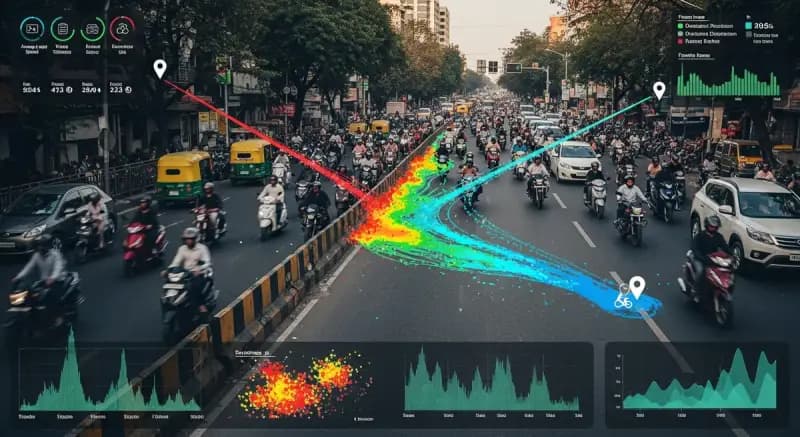
GPS-equipped volunteers (n=500 across five cities) completed journeys by two-wheeler, car, auto-rickshaw, and public transit. Routes matched for origin-destination pairs. Data collected over 12 months capturing seasonal and traffic variations.
Time Efficiency
Two-wheelers averaged 38% faster journey times than cars in peak traffic, 22% faster than autos, and 45% faster than bus transit (including walk/wait time). Time advantage increased with congestion levels.
Cost Efficiency
Per-kilometer cost for owned two-wheelers averaged Rs 1.80 (fuel plus amortized purchase). Car ownership: Rs 8.50. Auto-rickshaw: Rs 12. Ride-sharing two-wheeler: Rs 6. The economic case for two-wheelers is compelling for price-sensitive users.
Safety Trade-off
Two-wheelers are disproportionately represented in traffic fatalities (37% of deaths, 75% of vehicles). The time and cost benefits must be weighed against substantially elevated risk. Users interviewed acknowledged but discounted risk.
Environmental Consideration
Per-kilometer emissions favor two-wheelers over cars for CO2, but absolute emissions remain significant given fleet size. Electric two-wheeler transition would yield substantial air quality improvement given the mode's dominance.
Policy Implications
Two-wheeler dominance reflects rational response to traffic conditions and economics. Policies should improve two-wheeler safety rather than restrict usage. Electrification incentives for two-wheelers offer high environmental return.
Source: Centre for Sustainable Mobility, IIIT Hyderabad. (2024). Journal of Transport Geography, 112, 103689.
Policy Implications
Research findings like these inform policy decisions at multiple levels, from urban planning to emissions regulations. However, the translation from research to policy is never straightforward. Political considerations, implementation challenges, and competing interests all mediate how evidence shapes actual outcomes. Engaged citizens can advocate for evidence-based policymaking.
Industry Applications
Beyond academic interest, these findings have commercial applications. Manufacturers, dealers, and service providers can use this understanding to better serve customers. Some will embrace these insights; others will resist change. Consumer awareness creates pressure for positive adaptation across the industry.
Limitations and Future Research
No study is definitive. Acknowledged limitations point toward future research needs. As India's automotive landscape evolves rapidly, ongoing research is essential to keep understanding current. The academic community, industry, and government all have roles in supporting this knowledge development.
Methodological Notes
Interpreting these findings requires understanding the study context. Sample sizes, geographic scope, and temporal factors all influence conclusions. Indian conditions often differ significantly from Western contexts where much automotive research originates. Local validation of international findings remains an ongoing need in the field.
At Nxcar, our fascination with automobiles includes their role in shaping India's future. This research reflects that perspective.