
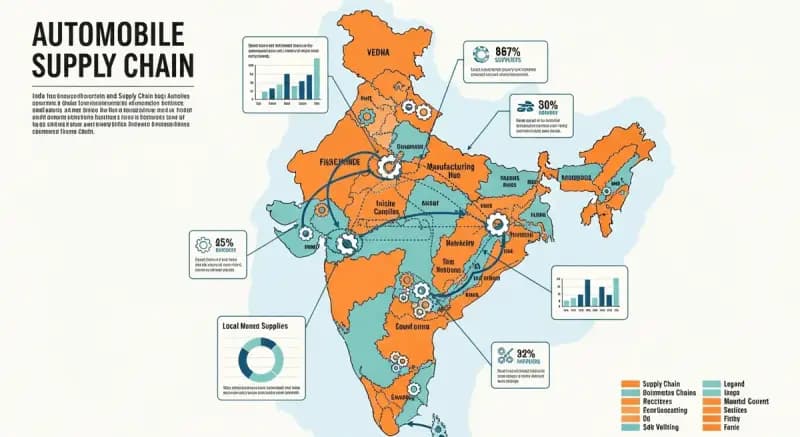
Abstract: The COVID-19 pandemic and subsequent semiconductor shortage exposed fragilities in automotive supply chains. This study analyzes supply chain vulnerabilities in Indian automobile manufacturing and evaluates resilience strategies adopted by leading manufacturers.
Vulnerability Assessment
Indian automotive supply chains show concentration risks in: semiconductors (90% imported, primarily from Taiwan and South Korea), rare earth elements (China-dependent), and specialized alloys (limited domestic production).
Just-in-time inventory practices, while cost-efficient, created fragility when disruptions occurred. Average inventory coverage fell below 2 weeks for critical components during normal operations.
Disruption Impacts
The semiconductor shortage reduced Indian vehicle production by approximately 800,000 units in 2021-2022. Revenue losses exceeded Rs 50,000 crore. Employment impacts were partially mitigated by government support.
Resilience Strategies
Post-disruption adaptations include: increased inventory buffers for critical components (now averaging 4-6 weeks), supplier diversification programs, domestic localization investments (particularly for semiconductors), and scenario planning for future disruptions.
Tata Motors established alternative sourcing for 60% of previously single-source components. Maruti Suzuki invested in buffer stocks despite inventory carrying costs. Mahindra pursued vertical integration for critical systems.
Policy Recommendations
Government incentives for domestic semiconductor manufacturing are essential. Strategic reserves for critical materials deserve consideration. Industry-wide information sharing about supplier risks could improve collective resilience.
Source: Indian Institute of Management Bangalore. (2024). Journal of Operations Management, 69, 44-68.
Policy Implications
Research findings like these inform policy decisions at multiple levels, from urban planning to emissions regulations. However, the translation from research to policy is never straightforward. Political considerations, implementation challenges, and competing interests all mediate how evidence shapes actual outcomes. Engaged citizens can advocate for evidence-based policymaking.
Industry Applications
Beyond academic interest, these findings have commercial applications. Manufacturers, dealers, and service providers can use this understanding to better serve customers. Some will embrace these insights; others will resist change. Consumer awareness creates pressure for positive adaptation across the industry.
Limitations and Future Research
No study is definitive. Acknowledged limitations point toward future research needs. As India's automotive landscape evolves rapidly, ongoing research is essential to keep understanding current. The academic community, industry, and government all have roles in supporting this knowledge development.
At Nxcar, we're curious about every aspect of automobiles , from hood ornaments to urban planning implications.