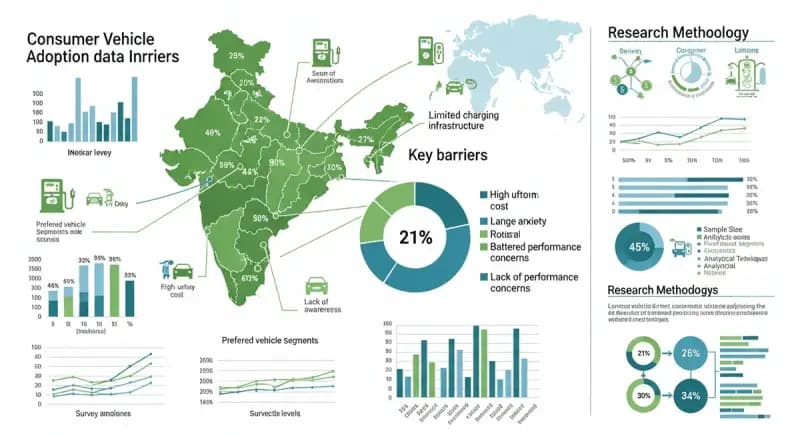
Abstract: Despite environmental benefits and declining costs, electric vehicle adoption remains slow in most markets. This comparative study examines adoption barriers across six countries (India, China, Norway, Germany, USA, Japan) using consistent survey methodology. Results reveal that barriers vary systematically by development stage, with infrastructure concerns dominating in developing markets while cost concerns persist even in developed markets.
Research Framework
We surveyed 2,000 potential car buyers in each country using translated but otherwise identical instruments. Respondents evaluated 15 potential EV adoption barriers on 1-7 importance scales. Factor analysis identified four underlying barrier dimensions: infrastructure concerns, cost concerns, range/performance concerns, and technology uncertainty.
India-Specific Findings
Indian respondents rated barriers as follows (mean importance, 1-7 scale):
Charging infrastructure availability: 6.2
Purchase price: 5.8
Resale value uncertainty: 5.7
Electricity reliability: 5.4
Range limitations: 5.1
Battery replacement cost: 5.0
Charging time: 4.8
Performance capability: 3.2
Infrastructure concerns dominate, consistent with actual infrastructure gaps. Electricity reliability, a barrier absent in developed markets, reflects India-specific power supply concerns.
Related Reading
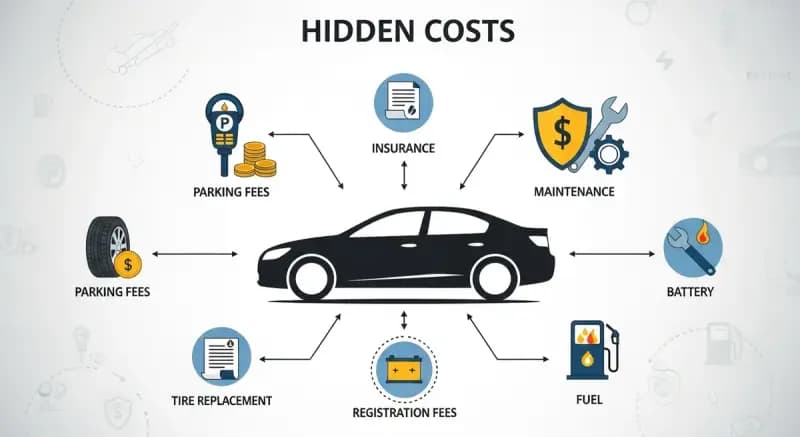
The Hidden Costs of Car Ownership Nobody Warns You AboutCross-Country Comparison
Infrastructure barriers are highest in India (6.2) and lowest in Norway (2.8), directly corresponding to actual charging point density. Cost barriers show less variation, remaining significant even in Norway (4.5) where subsidies substantially reduce purchase prices.
Interestingly, range anxiety shows non-linear relationship with actual range: highest in moderate-range markets (India, developing China) where ranges hover near daily needs, lower in both limited-range (short-range city EVs) and extended-range markets.
Related Reading
Understanding Vehicle Electrical Systems: 12V to 48V MigrationSegment Analysis
Two-wheeler buyers in India show significantly lower barriers than four-wheeler buyers, explaining faster two-wheeler electrification. Lower prices, shorter charging times, and home-charging sufficiency address key concerns.
Urban Indian buyers show 25% lower barrier scores than rural buyers, suggesting urban areas will lead adoption, consistent with current patterns.
Policy Implications
For India, infrastructure investment offers highest barrier reduction per rupee spent. Cost subsidies, while popular, address a barrier already declining through technological progress. Policies should prioritize: charging network expansion, electricity reliability improvement (particularly for home charging), and information campaigns addressing resale value uncertainty.
Source: International Electric Vehicle Study Consortium. (2024). "Global EV Adoption Barriers: A Six-Country Analysis." Energy Research & Social Science, 98, 102987.
Limitations and Future Research
No study is definitive. Acknowledged limitations point toward future research needs. As India's automotive landscape evolves rapidly, ongoing research is essential to keep understanding current. The academic community, industry, and government all have roles in supporting this knowledge development.
Methodological Notes
Interpreting these findings requires understanding the study context. Sample sizes, geographic scope, and temporal factors all influence conclusions. Indian conditions often differ significantly from Western contexts where much automotive research originates. Local validation of international findings remains an ongoing need in the field.
At Nxcar, we're curious about every aspect of automobiles , from hood ornaments to urban planning implications.