
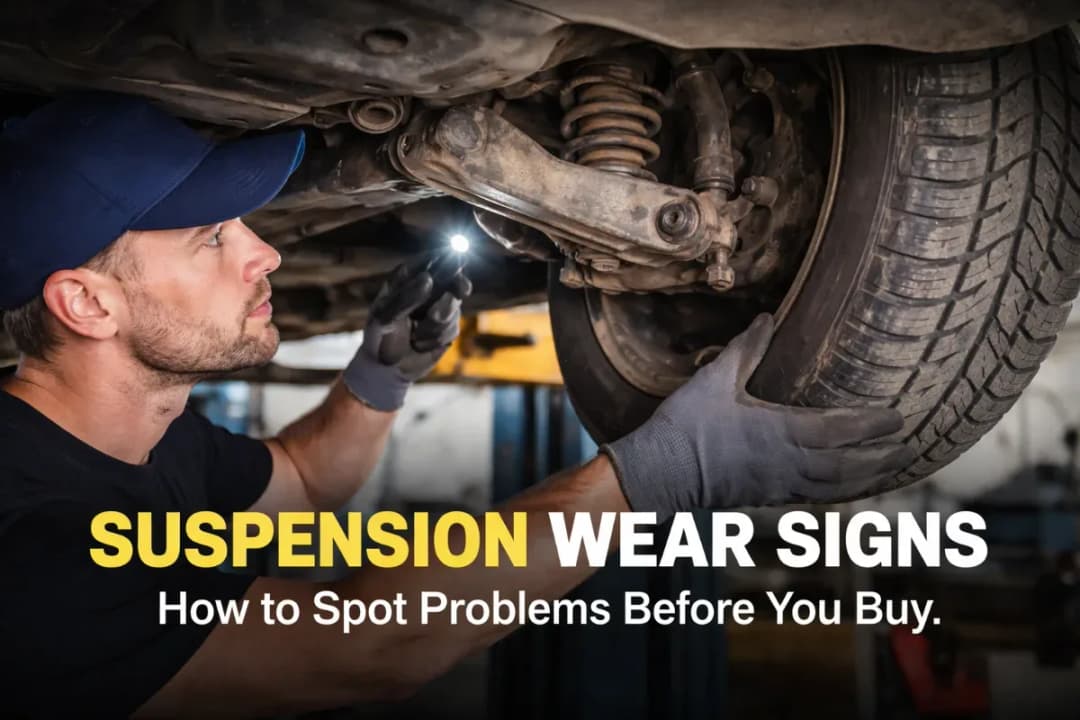
Quick Summary: Suspension condition is one of the most overlooked areas in India's used car market — and one of the most expensive to fix after purchase. Worn shocks, cracked bushings, failing ball joints, and sagging springs directly affect safety, tyre life, and braking. Before you finalise any used car deal, here is what to check, what to listen for on a test drive, and how to use your findings to negotiate smarter.
You're test-driving a used car. It feels fine on smooth roads. The seller seems confident. The odometer reads a reasonable number. But the moment you hit a speed breaker or a pothole — and you will, because this is India — something feels off. A clunk here. A shimmy there. The car bouncing a little longer than it should.
Most buyers dismiss these as minor. They are not minor.
Suspension condition is one of the most overlooked areas in India's used car market. It directly affects safety, tyre life, steering response, and braking. And because suspension wear is gradual, even the previous owner may not have noticed how far things had deteriorated. Before you finalise any used car purchase, here is what to check, what to listen for, and what it all means for your money.
What Your Tyres Are Already Telling You
Before any mechanic lifts the car, the tyres tell the suspension's story. Run your hand across each tyre's tread from the inside edge to the outside edge. The wear should feel even. If one edge is significantly more worn than the other, the suspension has a problem affecting wheel alignment.Here is what specific patterns mean:
- Cupping or scalloping — dips around the circumference of the tyre — indicates worn shock absorbers that are no longer controlling bounce properly
- Inner or outer edge wear — the tyre wearing heavily on one side — points to a camber alignment issue, often from worn ball joints or control arm bushings
- Feathering — where tread blocks feel smooth on one side and sharp on the other — suggests a toe alignment problem from suspension shift
In India's city driving conditions — constant braking, potholes, speed breakers, and overloaded roads — suspension components wear faster than most buyers expect. A car that has spent its life in Delhi or Mumbai traffic may show tyre wear patterns that reveal years of neglect in a single glance.
A simple check: measure tread depth at three points on each tyre — inside edge, centre, and outside edge. A difference of more than 2mm between edges means something in the suspension is out of alignment and needs investigation.
The Sounds a Neglected Suspension Makes
Your ears are one of the best inspection tools you have. A properly functioning suspension is nearly silent. When components wear, they make very specific sounds.Clunking over bumps is the most common warning sign. It means metal is hitting metal somewhere it should not be — usually worn ball joints, loose control arm bushings, or failed shock mounts. In India, where speed breakers appear every few hundred metres, this sound will surface quickly on any test drive if the problem exists.
Squeaking or creaking, especially when cold or over slow bumps, points to dried or cracked rubber bushings. These are the rubber components throughout the suspension that absorb vibration and allow controlled movement. When they deteriorate — which happens faster in India's summer heat — they squeak and eventually crack completely.
Knocking during turns is a different sound and points to different problems. Worn CV joints produce a rhythmic clicking during turns. Failed strut mounts create a knocking sound when the steering wheel is turned. Both are costly if ignored.
On your test drive, deliberately drive over a speed breaker slowly. Then drive over one at a moderate pace. Listen carefully. If you hear clunking, knocking, or squeaking, do not assume it is minor. Ask the seller directly what it is and watch how they answer.
How the Car Handles Tells You What the Tyres Cannot
Suspension problems do not just make noise. They change how the car behaves.Excessive bouncing after a bump is the most obvious sign of worn shock absorbers. A healthy suspension settles after one controlled movement. If the car continues to bounce two or three times, the shocks are finished. Try the simple push test: press down hard on each corner of the car and release. It should settle immediately. More than one bounce means those shocks need replacement.
Nose-diving during braking — where the front of the car dips sharply when you apply the brakes — indicates worn front struts. This is a safety issue. Braking distances increase, and weight distribution changes in a way that makes the car unpredictable in emergency situations. On Indian roads where sudden braking is routine, worn front struts are genuinely dangerous.
Excessive body roll in turns — the car leaning dramatically when you take a corner — means the sway bar components are worn. The sway bar is what keeps the car balanced through corners. When its links or bushings fail, the car leans excessively and feels unstable.
Pulling to one side while driving straight usually means uneven suspension wear, a sagging spring, or a seized strut on one side. Always check tyre pressure first, as that is the easiest cause. If pressures are correct and the pull continues, the suspension needs inspection.
What to Look for Visually Under and Around the Car
A physical inspection of the suspension components reveals problems that no test drive can fully expose.- Leaking shock absorbers: Look for oil residue along the shock body, particularly near the shaft. Any significant oil accumulation means the shock has lost its damping ability. In monsoon conditions and India's dusty roads, a leaking shock deteriorates rapidly once the seal fails.
- Cracked or torn rubber bushings: Healthy bushings are smooth and intact. Cracked, torn, or missing rubber means the metal components are moving more than they should, affecting alignment and generating noise.
- Worn ball joint dust boots: A torn boot means the joint has been exposed to dust and water — a serious problem in Indian road conditions. Test for play by lifting the car and trying to rock the tyre at the 12 and 6 o'clock positions. Any movement indicates worn ball joints or wheel bearings.
- Sagging or cracked springs: Check if the car sits level at all four corners. A car sitting noticeably lower on one corner has either a sagging spring or a broken one. Cracks typically form at the end coils and can be hidden under surface rust — use a torch and look carefully.
What Suspension Repairs Actually Cost in India
Understanding rough repair costs helps you negotiate or decide whether to walk away.- Shock absorber replacement (pair): Rs 4,000 to Rs 15,000 depending on the car and whether you use OEM or aftermarket parts
- Ball joint replacement: Rs 3,000 to Rs 12,000 per joint at an authorised centre
- Control arm bushing replacement: Rs 2,000 to Rs 8,000 per side
- Sway bar link replacement: Rs 1,500 to Rs 5,000 per side
- Spring replacement: Rs 5,000 to Rs 18,000 per corner
If an inspection reveals worn shocks, cracked bushings, and a failing ball joint together, you are looking at Rs 20,000 to Rs 50,000 in immediate repairs. That is documented, quantifiable leverage when negotiating price — not a vague complaint, but a specific number backed by findings.
A Simple Pre-Purchase Suspension Checklist
Before you commit to any used car in India, run through this:- Check all four tyres for uneven wear across the tread surface
- Push down on each corner and count bounces — more than one means worn shocks
- Drive deliberately over a speed breaker and listen for clunking or squeaking
- Brake moderately and notice whether the front dips sharply
- Take a corner at normal speed and check for excessive body lean
- Inspect shock absorbers for oil residue
- Look at visible bushings for cracks or missing rubber
- Check ride height at all four corners for signs of spring sag
A pre-purchase inspection from an independent mechanic costs between Rs 1,500 and Rs 5,000. On a car with suspension issues, that inspection can save you Rs 30,000 or more.
The Suspension Is Where the Car Meets the Road
Everything the car does — accelerating, braking, turning, absorbing a pothole — depends on the suspension working correctly.A car with worn suspension is not just uncomfortable. It is genuinely less safe, especially on Indian roads where the suspension is asked to do more every single day.
Check it before you buy. Use what you find to negotiate. And if the seller cannot explain why the car clunks over every bump, that is important information too. Nxcar's inspection process covers suspension as a core evaluation area — because condition is not just about what the car looks like. It is about what it does when the road gets rough.
FAQs
How do I quickly check suspension during a test drive in India?
Drive deliberately over a speed breaker at a moderate speed. Listen for clunking or squeaking. After the bump, notice how quickly the car settles. Excessive bouncing or noise indicates worn suspension components that need professional inspection.
What does uneven tyre wear mean on a used car?
It means a suspension or alignment problem is causing the tyre to ride unevenly on the road. The specific wear pattern — inner edge, outer edge, cupping, or feathering — points to different components. Any uneven wear should be investigated before purchase.
How much does suspension repair cost in India?
It varies significantly by car model and component. Shock replacements range from Rs 4,000 to Rs 15,000 per pair. Ball joints, bushings, and springs add to that. A car needing full suspension attention across multiple components can cost Rs 30,000 to Rs 60,000 or more to restore properly.
Can suspension problems affect braking in Indian driving conditions?
Yes. Worn front struts cause nose-diving during braking, which increases stopping distances. On Indian roads where sudden braking is routine, this is a genuine safety concern, not just a comfort issue.
Is a clunking sound over speed breakers always serious?
It depends on the source. A clunk from a worn ball joint is serious and requires immediate attention. A clunk from a worn sway bar link is less urgent but still needs fixing. Either way, any clunking sound should be diagnosed before purchase, not dismissed.