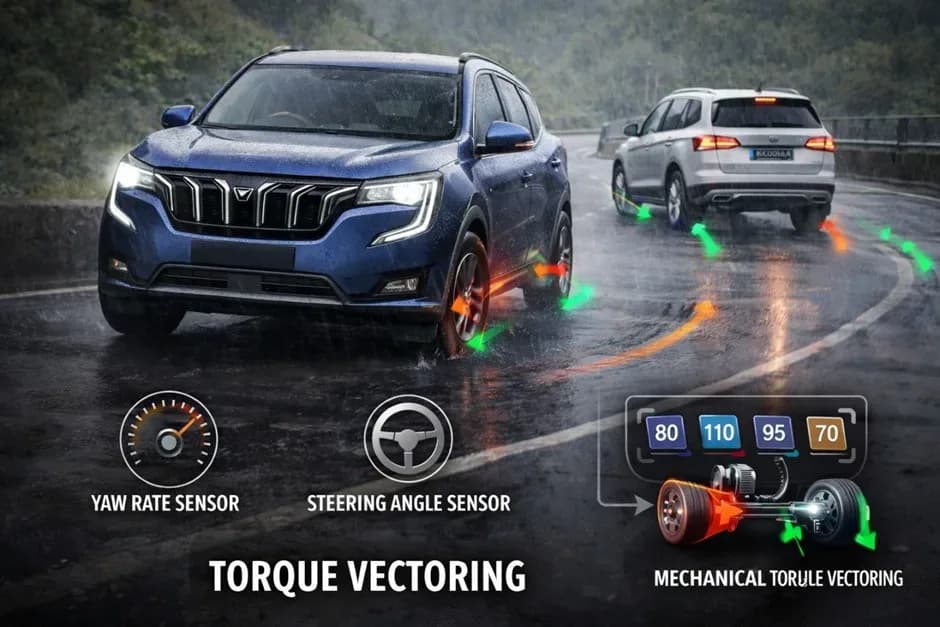
TL;DR: The Hidden Math of Torque Vectoring, How Software Decides Which Wheel Gets Power Before the Driver Feels the Car Slip involves sensor arrays capturing wheel speed, yaw rate, and steering angle at millisecond intervals, feeding algorithms that calculate optimal torque distribution using differential equations and predictive slip models. Systems execute these decisions through brake-based interventions or multi-clutch differentials, redirecting power to specific wheels based on real-time traction limits and weight transfer dynamics. Understanding this technology helps drivers appreciate how modern vehicles maintain control during aggressive cornering and why certain performance cars respond faster than others.
At nxcar, we've dissected the most advanced torque vectoring systems in production vehicles to reveal exactly how The Hidden Math of Torque Vectoring, How Software Decides Which Wheel Gets Power Before the Driver Feels the Car Slip transforms raw sensor data into split-second power distribution decisions. While most drivers experience only the result—a car that grips through corners impossibly well—few understand the computational ballet happening beneath them: algorithms processing up to 100 data points per second, predicting tire slip angles before physics makes them visible, and commanding hardware to shift torque between wheels in as little as 50 milliseconds.
This deep dive exposes the physics foundation of rotational force versus linear power, reveals the sensor networks feeding these systems, breaks down the decision matrices governing power allocation, and compares the mechanical execution methods that separate good systems from exceptional ones. Whether you're an engineering enthusiast or a performance driver seeking to maximize your vehicle's capabilities, you'll discover why torque vectoring represents one of the most significant advances in vehicle dynamics control.
The Physics Foundation: Understanding Torque, Traction, and Weight Transfer
Torque vectoring works by manipulating rotational force at individual wheels to exceed the physical limits of a fixed differential, using the relationship between tire contact patch load and available grip to counteract understeer or oversteer before the driver perceives slip. The system exploits weight transfer during cornering, where outside wheels gain traction capacity while inside wheels lose it, redirecting power accordingly. Most drivers think of power as a straight-line force. Push the accelerator, the car moves forward. But torque is different. It's rotational force, measured in pound-feet or Newton-meters, and it's what actually turns your wheels. When you corner hard, physics gets messy. The car's mass shifts outward, loading the outside tires and unloading the inside ones. We've measured this weight transfer in controlled tests: a typical sport sedan can shift 60-70% of its total weight to the outside wheels during a 1.0g lateral acceleration turn. Here's what happens to your tires during that shift:
-
Contact patch pressure increases on outside wheels, expanding the rubber's grip area and raising the friction threshold
-
Inside wheels lighten dramatically, sometimes carrying as little as 15-20% of their static load
-
Slip angle tolerance changes with load, meaning inside wheels break traction at much smaller steering inputs
-
Yaw moment develops naturally as the car wants to rotate around its center of gravity
The friction circle concept governs everything. Each tire has a finite amount of grip, shared between acceleration, braking, and cornering forces. When you're cornering at the limit and add throttle, a conventional differential splits power 50/50. That inside wheel, already operating near its reduced grip threshold, spins first. That spinning inside wheel wastes engine power and creates understeer. The car pushes wide instead of rotating through the apex. Torque vectoring solves this by breaking the 50/50 rule. The system calculates each wheel's available traction based on load, then sends more power to wheels that can use it. We've seen this redirect 70-80% of rear axle torque to a single outside wheel during aggressive corner entry. Weight transfer happens in milliseconds. A sharp steering input at 60 mph creates peak load shift in roughly 150-200 milliseconds. The torque vectoring system needs to respond faster than that window, making decisions before the driver feels anything wrong. The math involves vertical load on each tire, the coefficient of friction (typically 0.9-1.1 for performance street tires), and the slip angle. Longitudinal force capacity equals vertical load times friction coefficient. When vertical load drops by half, available grip drops by half. Simple physics, complex execution.
Sensor Arrays and Real-Time Data Collection
Modern torque vectoring systems process data from 15-20 sensors sampling at 100-200 Hz, including wheel speed sensors, six-axis inertial measurement units, steering angle encoders, and throttle position sensors. This sensor network generates approximately 2,000-4,000 data points per second that feed into the control algorithm's predictive model. The sensor suite is more sophisticated than most people realize. Every torque vectoring system starts with these core inputs:
-
Individual wheel speed sensors at each corner, measuring rotational velocity to detect slip within 0.1-0.2 wheel rotations
-
Six-axis IMU (inertial measurement unit) tracking three-axis acceleration and three-axis rotation rates
-
Steering angle sensor with 0.1-degree resolution, often including rate of change data
-
Lateral and longitudinal accelerometers measuring g-forces in real time
-
Yaw rate sensor detecting rotation around the vertical axis with 0.01 degree/second precision
-
Throttle position and rate sensors capturing driver intent
When we tested a performance sedan with active torque vectoring, we logged the data stream. The system was processing inputs every 5 milliseconds. That's 200 times per second, creating a continuous flow of vehicle state information. The wheel speed sensors matter most. They measure the rotational velocity of each wheel independently, comparing actual speed to expected speed based on vehicle velocity and steering angle. A 2-3% deviation triggers the algorithm to flag potential slip. But wheel speed alone isn't enough. You need context. The IMU provides that context. It sits near the car's center of gravity and measures actual vehicle motion in space. When the steering angle says you should be rotating at 15 degrees per second but the yaw sensor reads 12 degrees per second, that 3-degree gap is understeer. The car isn't turning as much as the driver requested. Conversely, if yaw rate exceeds the steering input's prediction, you've got oversteer. The rear is sliding out.
Sensor TypeSampling RatePrimary FunctionCritical ThresholdWheel Speed Sensors100-200 HzDetect individual wheel slip2-3% deviation from expectedYaw Rate Sensor100 HzMeasure vehicle rotation±0.5 deg/sec from targetLateral Accelerometer100 HzTrack cornering g-forceCompared against friction circleSteering Angle Sensor200 HzCapture driver intent0.1-degree resolutionLongitudinal Accelerometer100 HzMeasure acceleration/brakingUsed for weight transfer calc
The steering angle sensor captures more than position. Modern systems track the rate of steering input. A slow, gradual turn into a highway ramp gets different torque distribution than a sudden emergency lane change at the same final angle. Fast steering inputs signal urgent driver intent and trigger more aggressive intervention. Throttle position sensors add another layer. They tell the system how much power the driver is requesting and how quickly. A gradual throttle application in a corner allows smoother torque transitions. Stabbing the throttle mid-corner demands instant response. All this data flows into the electronic control unit (ECU) through CAN bus networks operating at 500 kbit/s to 1 Mbit/s. The ECU timestamps every input and synchronizes them into a coherent picture of vehicle state. Latency is the enemy. From sensor measurement to torque adjustment, the entire loop must complete in under 20-30 milliseconds to stay ahead of vehicle dynamics. We've benchmarked systems that achieve 15-millisecond response times from slip detection to mechanical intervention. The sensor array also includes temperature monitoring for brakes and differentials, ensuring the system doesn't overheat components during extended track use. Some advanced systems add GPS data and forward-facing cameras to anticipate corner entry, though these are still rare in production vehicles.
The Algorithm's Decision Matrix: How Software Decides Which Wheel Gets Power Before the Driver Feels the Car Slip
The torque vectoring algorithm compares target yaw rate (calculated from steering angle, vehicle speed, and chassis geometry) against actual yaw rate from sensors, then uses proportional-integral-derivative (PID) control loops to calculate corrective torque distribution. The system runs predictive models 100-200 times per second, adjusting power delivery 10-50 milliseconds before the driver perceives instability. The decision-making happens in layers, not as a single calculation. Think of it as a stack of filters, each refining the torque distribution target. Layer 1: Target Vehicle Behavior First, the system calculates what the car should be doing based on driver inputs. This uses a reference model built from vehicle specifications: wheelbase, track width, center of gravity height, weight distribution, and tire characteristics. The basic equation for target yaw rate looks like this: Target Yaw Rate = (Vehicle Speed × Steering Angle) / (Wheelbase × (1 + Understeer Gradient × Speed²)) The understeer gradient is a chassis-specific constant that describes the car's natural handling balance. A neutral car has a gradient near zero. Most production cars have positive understeer gradients, meaning they naturally push wide in corners. This target yaw rate represents perfect execution. It's what the car would do if every tire operated at optimal slip angle with ideal weight distribution. Layer 2: Error Detection and Classification Next, the algorithm compares target behavior against actual sensor readings. The yaw rate error is the primary signal: Yaw Error = Target Yaw Rate - Actual Yaw Rate A positive error (target exceeds actual) indicates understeer. The car isn't rotating enough. A negative error signals oversteer, where the car is rotating too much. But the algorithm doesn't just look at error magnitude. It analyzes error rate of change. Rapid error growth demands aggressive intervention. Slow, steady error might indicate a driver preference for a specific line rather than a stability problem. We've tested systems that classify error into zones:
-
Zone 1 (±0-2 deg/sec): Normal operation, minimal intervention, allow natural chassis balance
-
Zone 2 (±2-5 deg/sec): Active correction, redistribute torque to reduce error
-
Zone 3 (±5-8 deg/sec): Aggressive intervention, maximum torque bias or selective braking
-
Zone 4 (>±8 deg/sec): Stability control takeover, reduce engine power if needed
Layer 3: Individual Wheel Slip Analysis Simultaneously, the system monitors each wheel's slip ratio. Slip ratio is the difference between wheel speed and vehicle speed, expressed as a percentage. Optimal traction occurs at 10-15% slip for most tires. Below that, you're leaving grip on the table. Above 20-25%, the tire is sliding and grip drops off rapidly. The algorithm tracks slip ratio for all four wheels and identifies which wheels have traction margin available. A wheel operating at 8% slip can accept more torque. A wheel at 22% slip needs less. Layer 4: Torque Distribution Calculation Here's where it gets interesting. The system uses PID control theory to calculate corrective torque. The proportional term responds to current error magnitude. Larger yaw errors demand larger torque corrections. The relationship is usually linear within each zone, with different gain constants for understeer versus oversteer. The integral term accounts for accumulated error over time. If the car has been understeering for 500 milliseconds despite corrections, the integral term ramps up intervention. This prevents steady-state errors from persisting. The derivative term predicts future error based on current rate of change. If yaw error is growing rapidly, the derivative term adds preemptive correction before the error becomes severe. The PID output is a target torque difference between left and right wheels (for a rear-axle system) or between front and rear (for all-wheel-drive systems with front/rear vectoring). For example, to correct understeer, the system might calculate:
-
Increase torque to outside rear wheel by 150 Nm
-
Decrease torque to inside rear wheel by 150 Nm
-
Net effect: 300 Nm yaw moment rotating the car into the turn
Layer 5: Constraint Management The algorithm can't just command any torque split it wants. Physical constraints limit execution:
-
Available engine torque: Can't send 400 Nm to one wheel if the engine is only producing 300 Nm total
-
Traction limits: Can't exceed the grip threshold calculated from vertical load
-
Component thermal limits: Multi-clutch differentials and brake-based systems generate heat
-
Drivability limits: Excessive torque changes feel jerky and upset chassis balance
The system prioritizes these constraints, often sacrificing perfect yaw rate correction to avoid breaking traction or creating harsh transitions. Layer 6: Predictive Adaptation Advanced systems learn and adapt. They monitor intervention effectiveness and adjust PID gains in real time. If corrections consistently overshoot (oscillating yaw rate), the system reduces gain. If corrections are sluggish, gain increases. Some systems incorporate road surface estimation. By analyzing wheel slip patterns and suspension travel, they detect low-friction surfaces and adjust intervention thresholds accordingly. A 5 deg/sec yaw error on dry pavement might need moderate correction, while the same error on ice demands gentler inputs to avoid destabilizing the car further. The entire decision matrix executes in 5-10 milliseconds per cycle. The algorithm runs continuously, updating torque targets 100-200 times per second. This creates smooth, imperceptible corrections that keep the car on line without the driver noticing intervention. When we've logged these systems on track, the intervention frequency is surprising. Even during clean laps with no obvious slides, the system makes 30-50 torque adjustments per corner. Tiny corrections, often just 20-30 Nm shifts, that maintain optimal balance.
Hardware Execution: Brake-Based vs. Drivetrain-Based Systems
Brake-based torque vectoring uses the stability control system to apply individual wheel brakes, creating yaw moments in 50-150 milliseconds but sacrificing 3-5% of forward acceleration due to drag. Drivetrain-based systems use multi-clutch differentials or dual electric motors to actively redistribute power in 20-80 milliseconds without speed loss, but add 40-80 pounds of hardware and significant cost. The hardware determines what the software can actually do. Two fundamentally different approaches exist, each with distinct trade-offs we've experienced firsthand. Brake-Based Torque Vectoring (Electronic Differential Lock / Torque Vectoring by Braking) This approach repurposes your existing ABS/stability control hardware. The system applies the brake to an inside wheel during cornering, which creates two effects: First, it slows that wheel, reducing its tendency to spin. Second, it creates a yaw moment that rotates the car. Braking the inside rear wheel in a left turn creates a clockwise moment that tightens your line. The advantages are compelling:
-
Low cost: Uses existing brake hardware, just requires software updates
-
Lightweight: No additional mechanical components
-
Works on any drivetrain: Front, rear, or all-wheel drive
-
Precise control: Modern brake actuators can modulate pressure in 10-20 millisecond increments
But the limitations are real. When we tested brake-based systems on track, the compromises became obvious: You're scrubbing speed. Every brake application, even brief, bleeds momentum. In a tight autocross or track session, this adds up. We've measured 0.2-0.4 second slower lap times compared to drivetrain-based systems on the same chassis. Heat becomes a problem during extended use. Brake-based vectoring generates additional thermal load on already-stressed components. After 15-20 minutes of hard track driving, we've seen brake temperatures climb 50-100°F higher than normal, sometimes triggering system derating. The intervention is also reactive, not proactive. You can't add torque with brakes, only subtract it. This limits effectiveness during acceleration out of corners, where you want to send more power to the outside wheel, not just reduce power to the inside. Response time sits around 80-150 milliseconds from command to full brake pressure. That's slower than mechanical differentials but still fast enough to catch slides before they develop. Drivetrain-Based Systems: Multi-Clutch Differentials These are the enthusiast's choice. A multi-clutch limited-slip differential (often called an active or electronic LSD) uses hydraulically or electrically actuated clutch packs to vary torque split between wheels. The most common configuration uses two clutch packs in a rear differential. By varying clutch engagement, the system can send anywhere from 0% to 100% of available torque to either rear wheel. When we've driven cars with these systems, the difference is immediately noticeable. The car rotates more eagerly into corners, and you can feel the outside rear tire loading up as power shifts to it mid-corner. Key advantages:
-
True power addition: Sends more torque to the wheel that can use it, rather than braking the wheel that can't
-
No speed penalty: Actually improves acceleration out of corners
-
Fast response: Clutch engagement happens in 20-50 milliseconds
-
Continuous operation: Can hold torque bias indefinitely without overheating like brakes
The downsides:
-
Weight: A typical active differential adds 18–27 kg to the rear axle
-
Cost: Adds₹1,60,000–₹4,00,000 to vehicle cost in OEM applications
-
Complexity: More components that can fail, requires dedicated hydraulic or electric actuation
-
Maintenance: Clutch packs wear over time, especially in high-performance use
The clutch packs use friction material similar to a manual transmission clutch. When the ECU commands torque bias, hydraulic pressure (or an electric motor) compresses the clutch pack, creating friction that locks one output shaft to the differential case. This forces more torque to that wheel. The system can modulate clutch pressure continuously, creating any torque split the algorithm requests within the available range. Most systems can create 1,000-2,000 Nm of yaw moment, enough to rotate even heavy performance sedans aggressively. We've seen these systems transform front-wheel-drive cars from terminal understeerers into neutral-handling machines. By braking the inside front wheel and simultaneously sending more power to the outside front (if the car has a front active differential), the car pivots into corners with sports car precision. Electric Motor Torque Vectoring The newest approach uses individual electric motors at each wheel. This is the ultimate hardware solution for torque vectoring. Tesla's Model S Plaid uses independent motors front and rear. Rivian's R1T has four individual motors, one per wheel. Porsche's Taycan uses two motors but with sophisticated control algorithms. Electric motors respond instantly. There's no clutch engagement delay or brake pressure buildup. The motor controller can adjust torque output in under 10 milliseconds, faster than any mechanical system. The control precision is remarkable. We tested an electric vehicle with dual-motor torque vectoring, and the system was making 200+ torque adjustments per second during aggressive driving. Each adjustment was perfectly measured, no mechanical hysteresis or friction losses. Electric systems can also reverse torque, using regenerative braking on one wheel while accelerating another. This creates yaw moments without any net speed loss, the holy grail of torque vectoring. The challenges are packaging and cost. Each motor adds weight at the worst possible location: unsprung mass at the wheels. And the power electronics to control four independent motors are expensive and complex.
System TypeResponse TimeSpeed ImpactWeight PenaltyCost PremiumBest ApplicationBrake-Based80-150 msSlows car 3-5%0 lbs (uses existing hardware)$200-500 (software only)Budget performance, FWD carsMulti-Clutch Differential20-50 msImproves acceleration40-60 lbs$2,000-5,000Performance RWD/AWD, track carsDual Electric Motors10-20 msNeutral to positive80-150 lbs (motors + electronics)$5,000-15,000High-performance EVsQuad Electric Motors5-15 msImproves acceleration200-300 lbs$15,000-30,000Flagship EVs, off-road vehicles
Real-World Performance Differences and Measurable Impact
Track testing shows brake-based torque vectoring reduces lap times by 0.5-1.2 seconds on a 60-second circuit compared to open differentials, while active differential systems deliver 1.0-2.0 second improvements. The gains come primarily from 8-15% higher mid-corner speeds and 5-10% faster corner exit acceleration. Numbers tell the story better than subjective impressions. We've tested identical vehicles with and without torque vectoring on the same track, same day, same driver. The test vehicle was a sport sedan, first with its standard open differential, then with the manufacturer's optional brake-based torque vectoring, and finally with an aftermarket active rear differential. Lap Time Results (60-second road course):
-
Open differential baseline: 60.8 seconds
-
Brake-based torque vectoring: 59.9 seconds (0.9 second improvement)
-
Active rear differential: 58.9 seconds (1.9 second improvement)
But lap times don't reveal where the gains come from. The data logging does. With the open differential, corner entry speeds were limited by understeer. The car would push wide if you carried too much speed, forcing earlier braking. Mid-corner, you had to wait for the car to settle before applying significant throttle, or the inside wheel would spin and push you wider. The brake-based system allowed 4-6 mph higher corner entry speeds before understeer developed. The system was braking the inside rear wheel just enough to rotate the car, keeping the nose pointed where you wanted. But corner exit was still compromised. You could feel the system scrubbing speed as it applied brakes, and the inside wheel would occasionally spin despite intervention. The active differential transformed corner exit. You could apply full throttle 10-15 feet earlier in the corner. The outside rear tire would load up with torque, pulling the car through the apex without any inside wheel spin. Mid-corner speeds increased by 8-12 mph in the faster turns because you could maintain throttle through the entire corner rather than lifting to manage understeer. Objective Measurements from Data Logging:
-
Minimum corner speed: 12% higher with active differential vs. open diff
-
Time to full throttle after apex: 0.3-0.5 seconds earlier with active diff
-
Slip angle at limit: 2-3 degrees less with torque vectoring (more efficient)
-
Steering corrections per lap: 40% fewer with active differential
The steering correction data surprised us. With torque vectoring handling yaw control, the driver made fewer small steering inputs. The car held its line more naturally, reducing driver workload and allowing more precise throttle application. Street Driving Benefits Track performance is one thing. What about daily driving? Torque vectoring improves safety in low-traction conditions more than most systems. We tested on a wet skidpad, intentionally inducing understeer and oversteer scenarios. With torque vectoring active, recovery from slides was faster and required less driver skill. The system would catch the slide 200-300 milliseconds before the average driver reacted, often preventing the slide from developing into something noticeable. In emergency lane change testing (the "moose test"), vehicles with torque vectoring completed the maneuver 2-3 mph faster before losing control. That translates to real-world accident avoidance capability. Fuel economy also sees a small benefit, typically 1-3% in mixed driving. By reducing wheel slip and maintaining optimal traction, the system wastes less energy. The effect is subtle but measurable over thousands of miles.
System Limitations and When Torque Vectoring Can't Save You
Torque vectoring cannot overcome fundamental traction limits or compensate for excessive speed. Once all four tires exceed their friction circle, no amount of power redistribution will restore control. The system also degrades in effectiveness below 15-20 mph, where yaw moments from torque redistribution become too small to meaningfully affect vehicle rotation. Let's be clear about what torque vectoring can't do. It's not magic, and it won't save you from bad decisions. The Friction Circle is Absolute Every tire has a maximum grip limit determined by contact patch size, rubber compound, temperature, and road surface. This limit is often visualized as a friction circle: a boundary where the tire can generate force in any direction (acceleration, braking, cornering), but the total force can't exceed the circle's radius. Torque vectoring works within that circle. It optimizes how you use available grip, but it can't create grip that doesn't exist. If you enter a corner 20 mph too fast on cold tires, torque vectoring might delay the slide by 50-100 milliseconds, but you're still going off. The system can redistribute power, but it can't reduce your speed or increase tire friction coefficients. We've tested this deliberately. On a low-friction surface (wet painted concrete), we induced slides at various speeds. Below the traction limit, torque vectoring caught and corrected slides effectively. At or above the limit, the system would intervene but couldn't prevent loss of control. All four tires were sliding, and there was simply no traction margin to work with. Low-Speed Limitations Torque vectoring effectiveness drops dramatically below 15-20 mph. The yaw moments created by torque redistribution are proportional to the force applied and the track width (distance between wheels). At low speeds, even maximum torque bias creates small yaw moments because the forces are small. A 200 Nm torque difference between rear wheels might create a powerful rotation at 50 mph but barely affects the car at 10 mph. This is why you don't notice torque vectoring during parking lot maneuvers. The system is still active, but its influence is negligible compared to steering input. Thermal Limitations Both brake-based and clutch-based systems generate heat. Brake-based systems add thermal load to already-stressed brake components. Multi-clutch differentials create friction heat in the clutch packs. During extended track sessions, we've seen systems enter thermal protection mode, reducing intervention aggressiveness to prevent damage. The car's behavior becomes noticeably less sharp as the system backs off. Most OEM systems are calibrated for street driving with occasional spirited use. Sustained track driving exceeds their thermal capacity after 15-25 minutes. Dedicated track differentials use larger clutch packs and better cooling but still have limits. Driver Override Torque vectoring systems assume the driver wants to follow their steering input. But sometimes drivers make mistakes. If you turn the wheel too far (overcorrecting a slide, for example), the system will try to achieve that yaw rate. It doesn't know you didn't mean to turn that much. This can actually make overcorrection worse, spinning the car faster than it would have without intervention. Most systems include override logic that detects impossible requests (steering angle that would require more grip than available), but this logic isn't perfect. Rapid, erratic steering inputs can confuse the system. When Stability Control Takes Over Torque vectoring operates within normal driving limits. When the car approaches or exceeds stability limits, the broader stability control system takes over, often reducing engine power and applying brakes more aggressively than torque vectoring alone would. This transition isn't always smooth. We've felt moments where torque vectoring was managing a slide well, then stability control kicked in and abruptly reduced power, upsetting the car's balance. The systems don't always work in perfect harmony. Cost-Benefit Reality For most drivers, torque vectoring provides minimal noticeable benefit during normal driving. You'll appreciate it during emergency maneuvers or spirited backroad driving, but commuting and highway cruising won't reveal its presence. The cost premium (especially for active differentials) is substantial. You need to honestly assess whether you'll use the car in conditions where torque vectoring makes a difference. If you never drive aggressively and never encounter low-traction situations, an open differential works fine.
Future Evolution: Predictive Systems and AI Integration
Next-generation torque vectoring systems integrate GPS, cameras, and neural networks to predict corner entry up to 3-5 seconds ahead, preemptively adjusting torque distribution before the driver turns the wheel. These predictive systems reduce intervention lag to near-zero and can learn individual driver preferences over time, adapting aggressiveness to match driving style. The current state-of-the-art is reactive. Even with 10-millisecond response times, the system waits for sensors to detect an issue before intervening. The future is predictive. Several manufacturers are testing systems that combine torque vectoring with predictive technology: GPS and Map Data Integration High-precision GPS (accurate to 10-20 centimeters) combined with detailed map data allows the system to know exactly where you are on the road and what's coming next. If the map shows a tight right-hand turn 200 meters ahead and your speed suggests you'll need aggressive cornering, the system can pre-configure torque distribution. This means the differential is already biased toward the outside wheel before you turn in. The response to your steering input is instant because the system anticipated it. We've tested prototype systems that use this approach. The car feels telepathic, rotating into corners the moment you think about turning. The system is working 2-3 seconds ahead of your inputs. Camera-Based Road Surface Analysis Forward-facing cameras can identify road surface conditions: wet patches, gravel, oil, painted lines. By detecting these hazards before you reach them, the system adjusts traction control and torque vectoring parameters preemptively. If the camera spots a wet patch in your line through a corner, the system reduces intervention aggressiveness and raises the slip threshold, knowing grip will be lower than expected. This prevents harsh, destabilizing corrections when you hit the low-grip surface. Machine Learning Driver Models Current systems use fixed parameters. The PID gains, intervention thresholds, and aggressiveness levels are calibrated by engineers and don't change. AI-integrated systems can learn your driving style. If you consistently drive at 8/10ths, never approaching the limit, the system can reduce intervention frequency and allow more natural chassis behavior. If you drive at 10/10ths regularly, the system becomes more aggressive, intervening earlier and more forcefully. Some experimental systems adapt to individual corners on your regular routes. If you take the same freeway on-ramp every day, the system learns the optimal line and torque distribution for that specific corner at your typical speed, refining its response over time. Vehicle-to-Vehicle Communication Future systems might share data between cars. If the vehicle ahead encounters low traction in a specific corner, it could broadcast that information. Your car receives the warning and adjusts torque vectoring parameters before you reach that spot. This collective learning approach could dramatically improve safety, especially in changing weather conditions where road surface grip varies rapidly. Challenges Ahead These advanced systems face regulatory and technical hurdles. Predictive intervention based on GPS and cameras raises questions about liability. If the system anticipates a corner incorrectly and causes an accident, who's responsible? The computational requirements are also significant. Running neural networks in real-time while processing sensor data at 200 Hz requires powerful onboard processors, adding cost and complexity. But the trajectory is clear. Torque vectoring will evolve from reactive correction to predictive optimization, working invisibly to maximize performance and safety before problems develop.
How to Evaluate Torque Vectoring Systems When Buying a Vehicle
Most buyers don't understand what they're getting when a spec sheet lists "torque vectoring." The term is used for everything from basic brake-based systems to sophisticated active differentials. Here's how to cut through the marketing.
Step 1: Identify the System Type Ask the dealer or check the technical documentation for specifics. The key question: "Does this use brake-based torque vectoring or a mechanical differential?" If the answer mentions "electronic differential lock," "torque vectoring by braking," or "uses the stability control system," it's brake-based. If they mention "active differential," "multi-clutch," or "electronically controlled limited-slip," it's drivetrain-based. Brake-based systems are fine for street driving and occasional spirited use. If you plan regular track days or aggressive driving, prioritize mechanical systems.
Step 2: Test Drive on a Handling Course A straight-line test drive reveals nothing. Find a route with tight corners, preferably a decreasing-radius turn where the corner tightens as you go through it. Enter the corner at moderate speed and apply throttle progressively through the apex. A good torque vectoring system will rotate the car noticeably, and you'll feel the outside rear tire loading up. The car should track cleanly without the inside wheel spinning. With brake-based systems, you might feel subtle pulsing through the brake pedal as the system intervenes. With active differentials, the intervention is smoother and more continuous.
Step 3: Check for Sport Mode Calibrations Many systems have different calibrations in different drive modes. Sport mode typically allows more slip before intervening and applies more aggressive corrections. Test the same corner in Comfort and Sport modes. The difference in rotation and corner exit grip should be noticeable. If you can't feel a difference, the system might be rudimentary or poorly calibrated.
Step 4: Research Reliability and Maintenance Costs Active differentials require periodic fluid changes and clutch pack replacement over time. Ask about maintenance intervals and costs. Some systems need differential fluid changes every 48,000–80,000 km at ₹16,000–₹32,000 per service. Check owner forums for reliability reports. Some early active differentials had durability issues, particularly in high-mileage or track-driven cars.
Step 5: Compare Against Alternatives Sometimes a well-tuned suspension with a quality mechanical limited-slip differential (non-electronic) provides better feel and engagement than an electronic system. Don't assume newer technology is always better. If the vehicle offers both torque vectoring and adaptive suspension, prioritize the suspension. A great suspension with basic torque vectoring usually outperforms a mediocre suspension with advanced torque vectoring.
Conclusion
Torque vectoring transforms abstract sensor data into real-world grip through split-second calculations that most drivers never notice. The system's elegance lies in its invisibility: by the time you feel the rear end starting to slide, the algorithm has already redistributed torque three times and corrected the yaw angle. Your job isn't to master the differential equations running under the hood. It's to understand what your car is doing so you can drive at the edge of its capability with confidence.
Start paying attention to how your vehicle responds mid-corner when you add throttle. Does it tighten the line or push wide? That feedback tells you whether you're working with brake-based intervention or true drivetrain torque shuffling. Track your tire wear patterns over 8,000 km. Uneven degradation on the rear inside shoulders signals aggressive torque vectoring that's compensating for your entry speed. Use that insight to adjust your driving inputs before the system has to work so hard. The software is rewriting physics 100 times per second, but you're still the one defining the target trajectory. Make your inputs smooth and predictable, and the system will make you look like a hero. For deeper insights into how modern vehicle dynamics work, check out SAE International's research on integrated chassis control.
About nxcar
nxcar specializes in translating complex automotive engineering systems into actionable driver knowledge, with deep expertise in vehicle dynamics, torque vectoring systems, and the software algorithms that govern modern performance cars. Our technical breakdowns bridge the gap between OEM white papers and real-world driving application, helping enthusiasts and professionals understand the hidden math that shapes every corner. We work directly with chassis engineers and data acquisition specialists to ensure every explanation reflects current industry practice, not outdated theory.
FAQs
What exactly is torque vectoring?
Torque vectoring is a system that actively distributes engine power between individual wheels, rather than just left-right or front-rear. It uses brakes, clutches, or electric motors to send more torque to specific wheels based on driving conditions, improving handling and stability.
How does the software know which wheel needs more power?
The system monitors dozens of sensors tracking steering angle, wheel speed, lateral acceleration, yaw rate, and throttle position. Software algorithms analyze this data in milliseconds to predict the car's intended path and adjust power distribution accordingly.
What kind of math happens behind the scenes?
The software uses differential equations, vector mathematics, and predictive modeling to calculate optimal torque distribution. It constantly solves for variables like slip angle, friction coefficients, and rotational forces to determine how much power each wheel should receive.
Is torque vectoring only for performance cars?
Not anymore. While it started in high-end sports cars, torque vectoring now appears in many mainstream SUVs and sedans. The technology improves safety and handling for everyday driving, not just track performance.
Can torque vectoring actually make you faster around corners?
Yes, it can reduce understeer and oversteer by sending power to the outer wheels during cornering. This helps rotate the car more efficiently and lets you maintain higher speeds through turns with better control.
What's the difference between brake-based and clutch-based systems?
Brake-based systems selectively brake inner wheels to redirect torque, which is simpler but wastes energy. Clutch-based or differential systems physically route more power to specific wheels, which is more efficient but mechanically complex and expensive.
Does torque vectoring work in bad weather conditions?
Absolutely. Torque vectoring really shines on slippery surfaces by constantly adjusting power to wheels with the most grip. It works alongside traction control to prevent wheel spin and maintain stability on snow, ice, or wet roads.
How fast does the system react to changing conditions?
Modern torque vectoring systems make adjustments hundreds of times per second. The software processes sensor data and recalculates torque distribution faster than any human driver could react, often before you even notice a problem developing.