Vehicle lighting has evolved from simple sealed beams to extraordinarily sophisticated systems incorporating adaptive control, LED matrices, and laser sources. This technology progression offers genuine safety benefits, at significant ownership cost implications.
Halogen Baseline
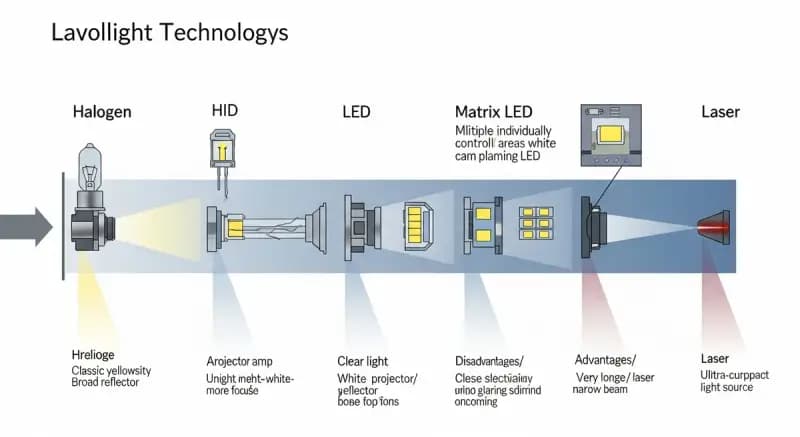
Halogen bulbs remain the default: tungsten filaments in halogen gas envelopes. Simple, cheap, replaceable. Output around 1,000-1,500 lumens. Lifespan 500-1,000 hours. Replacement cost: Rs 200-500.
HID/Xenon
High-Intensity Discharge lights arc electricity through xenon gas, producing 3,000+ lumens with distinctive blue-white color. Require ballasts and igniters as ancillary components. Bulb life 2,000+ hours, but ballast failures are common. Replacement costs: Rs 3,000-8,000 for bulbs, Rs 5,000-15,000 for ballasts.
LED Systems
LEDs offer instant-on, design flexibility, and efficiency. Output comparable to HID with lower power consumption. Life expectancy exceeds vehicle lifespan theoretically, but thermal management failures cause earlier death.
LED headlights are typically non-serviceable modules. When they fail, entire assemblies require replacement: Rs 15,000-50,000+ per side for standard vehicles, exceeding Rs 1 lakh for matrix systems.
Laser Headlights
Laser headlights (BMW, Audi) use laser diodes exciting phosphor for extreme intensity and range. Currently limited to high-beam assistance. Replacement costs are substantial.
Ownership Implications
Advanced lighting improves safety genuinely. But when failures occur, costs are painful. Budget accordingly for premium vehicles with sophisticated lighting, this is not a component where aftermarket substitutes work well.
Real-World Applications
Theory translates to practice in specific ways. Under Indian driving conditions, with their unique combination of heat, dust, traffic, and road quality, these technical factors manifest differently than in laboratory conditions. Owners should calibrate expectations accordingly, recognizing that advertised specifications often assume ideal conditions.
Future Developments
Automotive technology continues evolving rapidly. What seems cutting-edge today becomes standard tomorrow. Understanding current technical foundations helps owners anticipate future developments and make purchase decisions that won't become obsolete prematurely. The pace of change, particularly in electrification and connectivity, makes this foresight increasingly valuable.
Maintenance Implications
Technical understanding translates directly to maintenance strategy. Knowing how systems function helps owners prioritize servicing, recognize warning signs, and communicate effectively with service advisors. This knowledge pays dividends throughout the ownership period, often resulting in better vehicle condition and higher resale values.
Technical Considerations
Understanding these engineering principles helps owners make better maintenance decisions. When mechanics explain repairs, informed owners can evaluate recommendations critically. This knowledge prevents unnecessary work while ensuring critical maintenance isn't deferred. The goal isn't to become a mechanic but to be a smarter vehicle owner.
The Nxcar team believes that every car lover should understand their machine. This article helps bridge that gap.