In 1997, Toyota introduced the Prius with a hybrid system that seemed impossibly complex: two electric motor-generators, a planetary gear set, and software coordinating between three power sources. Competitors predicted quick failure. Instead, 25 years and 20 million hybrid sales later, Toyota's Hybrid Synergy Drive remains the benchmark. Here's the engineering brilliance that explains why.
The Power Split Device
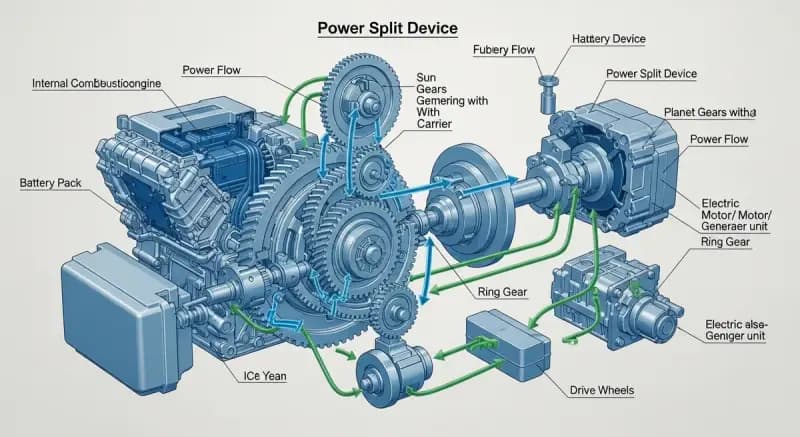
At the heart of Toyota's system lies the power split device, an elegantly simple planetary gear set that accomplishes what other manufacturers require expensive multi-speed transmissions to achieve. The ring gear connects to the wheels, the sun gear to Motor Generator 1 (MG1), and the planet carrier to the engine.
This arrangement enables continuously variable power distribution without friction-based CVT mechanisms. MG1's speed determines the effective gear ratio, allowing the engine to operate at peak efficiency RPM regardless of vehicle speed. The mechanical simplicity translates to legendary durability, Toyota hybrids routinely exceed 400,000 km without major powertrain issues.
Related Reading
Cars Expected to Get Massive Discounts This Year in IndiaThermal Management Excellence
Toyota's batteries are liquid-cooled with dedicated circuits that maintain optimal temperature regardless of ambient conditions. Competitive hybrids from Honda and others used air cooling, resulting in faster degradation in hot climates, like India. Toyota's thermal management explains why 15-year-old Priuses still operate with 85%+ battery capacity.
The cooling system also enables consistent performance. Where air-cooled systems reduce power output when hot, Toyota hybrids maintain full capability in traffic jams and high-temperature conditions.
Software Sophistication
The hybrid control computer makes thousands of decisions per second: when to start the engine, how to split torque between motor and engine, when to regenerate versus coast. Toyota has refined these algorithms over 25 years and millions of kilometers of real-world data.
Competitors starting fresh must guess at control strategies. Toyota knows from data exactly how to optimize for reliability, efficiency, and drivability, a knowledge advantage that takes decades to develop.
Economic Validation
The Innova Hycross delivers 21-23 km/l in real-world conditions, verified by owner reports, compared to 12-14 km/l for the diesel equivalent. Over a 100,000 km ownership period, fuel savings exceed Rs 2.5 lakh. Combined with lower maintenance (no clutch, reduced brake wear), the total cost of ownership favors the hybrid despite higher purchase price.
Toyota didn't just pioneer hybrids, they perfected them. Competitors are still catching up.
Technical Considerations
Understanding these engineering principles helps owners make better maintenance decisions. When mechanics explain repairs, informed owners can evaluate recommendations critically. This knowledge prevents unnecessary work while ensuring critical maintenance isn't deferred. The goal isn't to become a mechanic but to be a smarter vehicle owner.
Real-World Applications
Theory translates to practice in specific ways. Under Indian driving conditions, with their unique combination of heat, dust, traffic, and road quality, these technical factors manifest differently than in laboratory conditions. Owners should calibrate expectations accordingly, recognizing that advertised specifications often assume ideal conditions.
This technical deep-dive was curated by Nxcar's team of automotive enthusiasts. We believe understanding how cars work makes you appreciate them more.