Confusion between four-wheel drive (4WD), all-wheel drive (AWD), and their various implementations leads to purchase mistakes. These systems differ fundamentally in capability, complexity, and application.
Part-Time 4WD
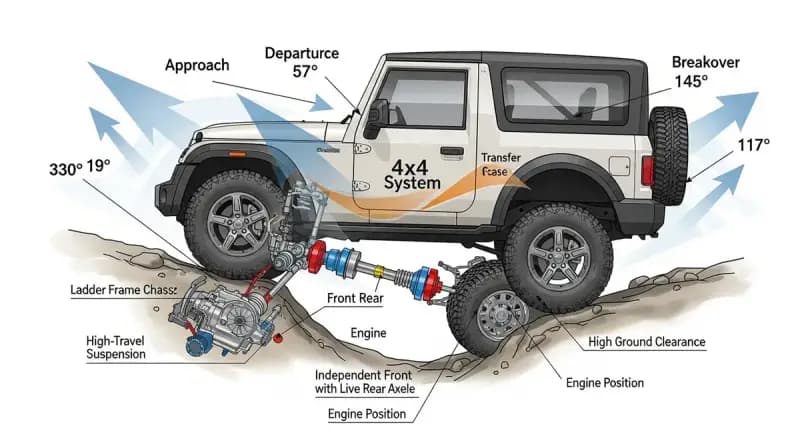
Traditional part-time systems (Thar, Fortuner, Endeavour) use transfer cases to engage front axles only when needed. A locking or limited-slip center differential distributes torque between axles. Part-time 4WD cannot safely operate on dry pavement, binding damages drivetrain.
Best for: genuine off-road use with primarily two-wheel-drive road driving. Robust, repairable, proven.
Full-Time 4WD
Full-time systems (Land Cruiser, some Range Rovers) maintain four-wheel drive constantly using center differentials that allow front-rear speed differences. Lockable center differentials provide maximum traction when needed.
Best for: mixed on-road/off-road use where 4WD benefits are desired always. Complex but capable.
AWD Systems
AWD typically uses electronically controlled clutch packs to distribute torque between axles as needed. These range from front-biased systems that engage rear wheels when slipping (Creta, Seltos AWD) to performance-focused systems with sophisticated torque vectoring.
Best for: on-road traction in adverse conditions. Limited off-road capability; not substitutes for proper 4WD.
Choosing Correctly
Match system to use case. For serious off-roading: part-time or full-time 4WD with low-range. For enhanced wet/snow traction: AWD suffices. For image without off-road intent: AWD or FWD honestly.
Many buyers purchase more capability than they'll ever use, and pay maintenance costs for unused complexity.
Technical Considerations
Understanding these engineering principles helps owners make better maintenance decisions. When mechanics explain repairs, informed owners can evaluate recommendations critically. This knowledge prevents unnecessary work while ensuring critical maintenance isn't deferred. The goal isn't to become a mechanic but to be a smarter vehicle owner.
Real-World Applications
Theory translates to practice in specific ways. Under Indian driving conditions, with their unique combination of heat, dust, traffic, and road quality, these technical factors manifest differently than in laboratory conditions. Owners should calibrate expectations accordingly, recognizing that advertised specifications often assume ideal conditions.
Future Developments
Automotive technology continues evolving rapidly. What seems cutting-edge today becomes standard tomorrow. Understanding current technical foundations helps owners anticipate future developments and make purchase decisions that won't become obsolete prematurely. The pace of change, particularly in electrification and connectivity, makes this foresight increasingly valuable.
This technical insight comes from Nxcar , a team that finds beauty in both chrome curves and combustion cycles.