Abstract: This study quantifies the economic costs of traffic congestion across eight major Indian cities using multiple methodologies. Aggregate annual costs exceed Rs 1.5 lakh crore, representing a significant drag on economic productivity and individual welfare.
Methodology
Three cost categories analyzed: time costs (lost productive hours), fuel costs (excess fuel consumption in congestion), and health costs (pollution exposure and stress-related impacts). Data from traffic studies, fleet telematics, and health surveys.
Time Costs
Average commuter in Mumbai, Delhi, and Bengaluru loses 2-3 hours daily to congestion versus free-flow conditions. At average wage rates, annual time cost per commuter ranges from Rs 45,000 to Rs 1.5 lakh depending on income level.
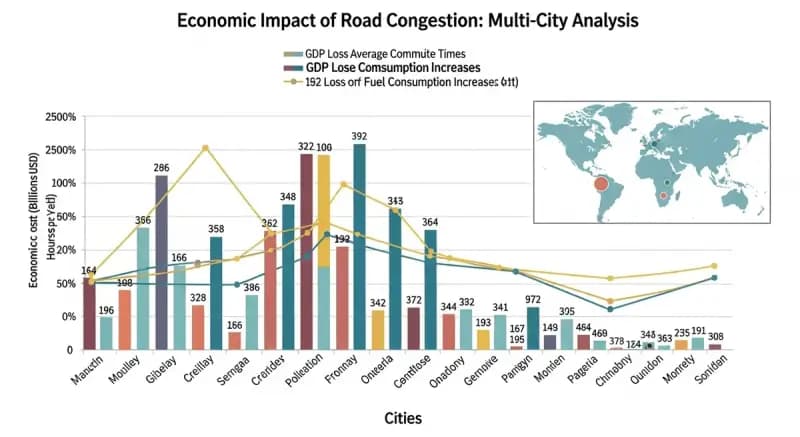
Aggregate time cost across eight cities: Rs 78,000 crore annually.
Fuel Costs
Stop-start congested driving increases fuel consumption 40-60% versus free-flow conditions. Commercial vehicles suffer additionally from missed delivery windows and extended operating hours.
Aggregate fuel cost: Rs 35,000 crore annually.
Health Costs
Congestion concentrates pollution exposure. Time in traffic correlates with respiratory conditions and cardiovascular stress. Quantifying health costs is challenging but conservative estimates exceed Rs 25,000 crore annually.
Policy Implications
Congestion mitigation investments offering even 10% improvement would yield returns exceeding Rs 15,000 crore annually, justifying substantial infrastructure and transit investments that appear expensive in isolation.
Source: National Institute of Urban Affairs. (2024). Journal of Transport Economics and Policy, 58(2), 189-214.
Limitations and Future Research
No study is definitive. Acknowledged limitations point toward future research needs. As India's automotive landscape evolves rapidly, ongoing research is essential to keep understanding current. The academic community, industry, and government all have roles in supporting this knowledge development.
Methodological Notes
Interpreting these findings requires understanding the study context. Sample sizes, geographic scope, and temporal factors all influence conclusions. Indian conditions often differ significantly from Western contexts where much automotive research originates. Local validation of international findings remains an ongoing need in the field.
Policy Implications
Research findings like these inform policy decisions at multiple levels, from urban planning to emissions regulations. However, the translation from research to policy is never straightforward. Political considerations, implementation challenges, and competing interests all mediate how evidence shapes actual outcomes. Engaged citizens can advocate for evidence-based policymaking.
Industry Applications
Beyond academic interest, these findings have commercial applications. Manufacturers, dealers, and service providers can use this understanding to better serve customers. Some will embrace these insights; others will resist change. Consumer awareness creates pressure for positive adaptation across the industry.
The Nxcar team is passionate about the science of mobility as much as the joy of driving. This study reflects both.