Abstract: This study develops empirical depreciation models for Indian automobile segments using transaction data from organized used car platforms. Results reveal significant segment and brand variations in depreciation trajectories, with implications for total cost of ownership calculations and residual value estimation.
Methodology
Transaction data from 180,000 used car sales on organized platforms over 36 months. Models estimated separately for hatchback, sedan, SUV, and luxury segments. Brand-specific intercepts capture residual value differences.
Aggregate Findings
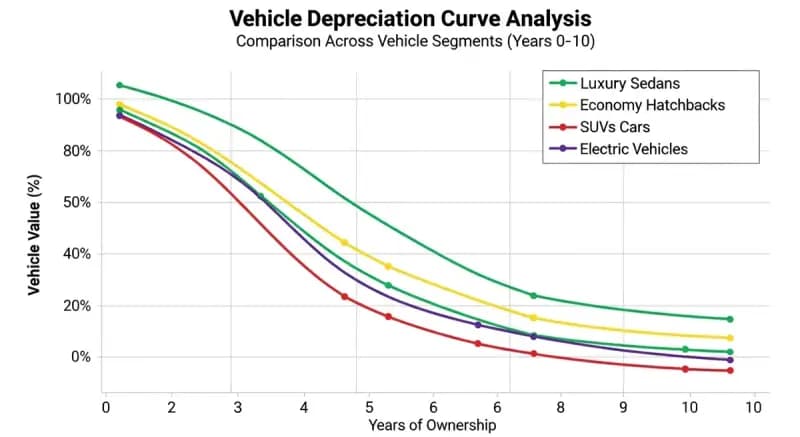
Average depreciation follows exponential decay: approximately 15% in year one, 12% in year two, 10% in year three, declining to 5-7% in years five and beyond. Total depreciation at 5 years averages 52%.
Segment Variation
Hatchbacks depreciate fastest: 58% at 5 years. Sedans: 54%. SUVs: 48%. Luxury: 62%. SUV slower depreciation reflects sustained demand; luxury rapid depreciation reflects maintenance concerns in secondary market.
Brand Effects
Maruti Suzuki vehicles retain 8-12% more value than segment average. Toyota: 6-8% premium. Hyundai: segment average. Tata: 5-8% below average, though improving in recent vintages. German luxury brands: 10-15% below luxury segment average.
Practical Applications
Total cost of ownership calculations should incorporate brand-specific depreciation. Financing decisions should consider residual values, low-residual vehicles impose higher effective financing costs. Used car buyers can identify value by targeting brands with below-average residual values for equivalent quality.
Source: Automotive Research Institute of India. (2024). International Journal of Automotive Technology and Management, 24(1), 67-89.
Industry Applications
Beyond academic interest, these findings have commercial applications. Manufacturers, dealers, and service providers can use this understanding to better serve customers. Some will embrace these insights; others will resist change. Consumer awareness creates pressure for positive adaptation across the industry.
Limitations and Future Research
No study is definitive. Acknowledged limitations point toward future research needs. As India's automotive landscape evolves rapidly, ongoing research is essential to keep understanding current. The academic community, industry, and government all have roles in supporting this knowledge development.
The Nxcar team curated this study because we believe informed citizens make better transportation choices.