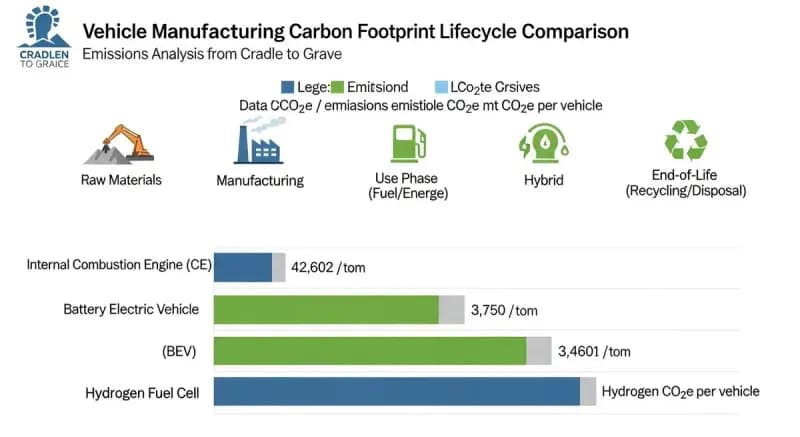
Abstract: This life cycle assessment compares the carbon footprint of manufacturing petrol vehicles, diesel vehicles, hybrid vehicles, and battery electric vehicles in Indian production conditions. Results provide essential context for evaluating climate benefits of electrification given manufacturing emissions.
Scope and Boundaries
Cradle-to-gate analysis covering: raw material extraction, material processing, component manufacturing, and vehicle assembly. Excludes use-phase emissions (covered in separate analysis). Indian production conditions assumed including grid electricity mix.
Manufacturing Emissions
Petrol vehicle (mid-size sedan): 8.2 tonnes CO2e
Diesel vehicle (mid-size sedan): 8.8 tonnes CO2e
Hybrid vehicle (mid-size sedan): 10.4 tonnes CO2e
BEV 50 kWh battery: 14.6 tonnes CO2e
BEV 75 kWh battery: 18.2 tonnes CO2e
Battery Contribution
Battery manufacturing contributes 6-10 tonnes CO2e depending on capacity and chemistry. This represents 40-55% of total BEV manufacturing emissions. Battery production location matters: Chinese coal-powered production generates 60% more emissions than production in renewable-heavy regions.
Break-Even Analysis
Despite higher manufacturing emissions, BEVs achieve climate benefit once use-phase emissions are included, but the break-even point depends on grid carbon intensity. On India's current grid, BEVs break even with petrol vehicles at approximately 60,000 km. On fully renewable electricity, break-even occurs at 25,000 km.
Implications
Electrification provides genuine climate benefits, but manufacturing emissions are substantial. Policies should address battery production emissions, not just use-phase benefits.
Source: The Energy and Resources Institute. (2024). Journal of Industrial Ecology, 28(3), 412-431.
Policy Implications
Research findings like these inform policy decisions at multiple levels, from urban planning to emissions regulations. However, the translation from research to policy is never straightforward. Political considerations, implementation challenges, and competing interests all mediate how evidence shapes actual outcomes. Engaged citizens can advocate for evidence-based policymaking.
Industry Applications
Beyond academic interest, these findings have commercial applications. Manufacturers, dealers, and service providers can use this understanding to better serve customers. Some will embrace these insights; others will resist change. Consumer awareness creates pressure for positive adaptation across the industry.
From Nxcar's research desk: Our passion for automobiles includes understanding the data that drives the industry.